admin
admin 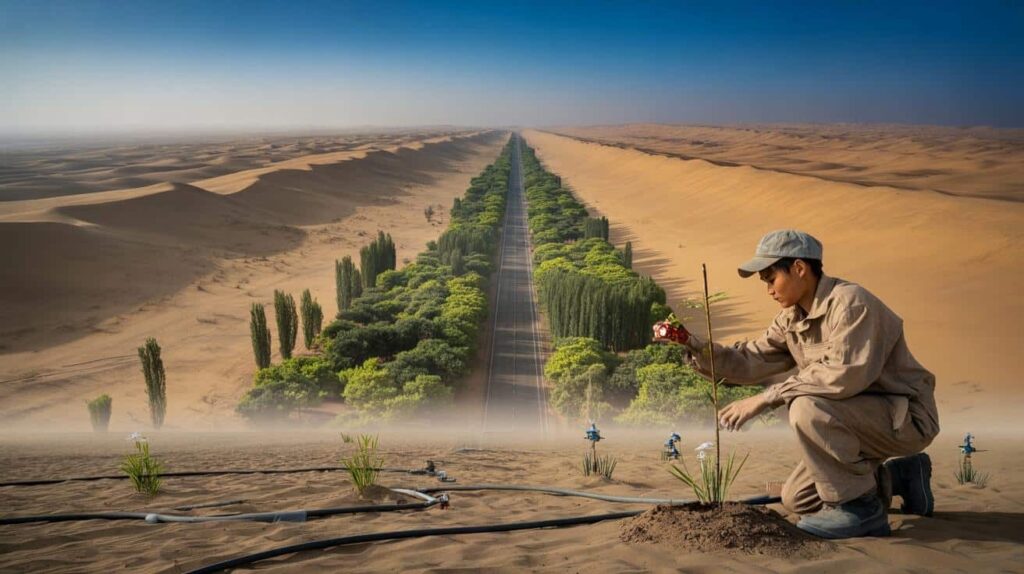
By Mawsel Marc / 23 February 2026
The first thing you notice is the sound. Not the roar of trucks or the whistle of the wind, but a soft rustle, like rain on canvas. It’s the leaves of poplars and desert willows brushing against each other, right where the sand dunes of the Taklamakan Desert used to roll on, uninterrupted, for hundreds of kilometers.
A young forestry worker in a faded cap tilts his thermos, eyes following a row of thin green trunks stretching into the heat haze. “When my father worked here, there was nothing,” he says. “Just sand, and more sand.”
Today, dust storms are rarer. Air feels heavier, almost moist. And somewhere in this improbable forest, satellite sensors have picked up a quiet revolution.
Something huge is happening beneath these leaves.
How China turned a “Sea of Death” into a surprising green belt
 The Taklamakan used to be described in two words: “no return”. Pilots dreaded its dust storms. Farmers hundreds of kilometers away dreaded its creeping dunes. Whole villages on the desert’s edge saw their fields swallowed, meter by meter, by a slow yellow tide.
Then came a radical idea that sounded almost naïve at first. What if you didn’t just build walls against the sand, but planted a living wall? Rows of trees, shrubs and grasses, carefully chosen, irrigated and monitored, wrapping the desert like a loose, green net.
On satellite images from the late 1990s, the Taklamakan looks like a pale bruise on the map. On recent images, you can see deep green bands tracing roads, rivers and the edge of the dunes. The bruise now has a border.
Drive along the Tarim Desert Highway today and the transformation feels almost cinematic. This road cuts straight through the Taklamakan for more than 500 kilometers, once flanked by nothing but rippling sand. Now, every few dozen meters, you spot water pipes, drip lines, and narrow shelterbelts of trees, some already taller than a house.
These are not random saplings thrown into the sand. Engineers and ecologists tested salt-tolerant poplars, tamarisks, sea-buckthorn, even hardy shrubs whose roots go down several meters. Workers planted in checkerboard patterns to pin dunes down. Sensors regulate drip irrigation so each tree gets just enough water, not a drop more.
Officially, China says it has planted billions of trees nationwide, and the Taklamakan is one of the most extreme test beds. You can actually feel it in the air when a sandstorm that once would have darkened the sky now fizzles out against a belt of green
What’s changed is not only the landscape, but the desert’s role in the global climate story. A place that used to be a massive dust source is now behaving, at least in part, like a carbon sponge. Trees take in CO₂ as they grow, storing it in trunks, roots and soil. Multiply that by thousands of square kilometers of shelterbelts and plantations, and you begin to see why scientists started paying close attention.
Field teams have gone into these new forests with portable chambers, gas analyzers and satellite data. Their measurements suggest that certain planted zones in and around the Taklamakan are now net carbon sinks: they absorb more CO₂ than they release.
It’s not magic. It’s photosynthesis, scaled up in one of the harshest places on Earth.
The hidden playbook behind greening a giant desert
 From the outside, it can look like a miracle: sand turning into forest. On the ground, it’s a grind of small, precise moves repeated thousands of times. Crews start by stabilizing dunes with straw checkerboards, pinning the sand in place so it doesn’t just swallow the next step.
Then they bring in water. Not rivers diverted blindly, but carefully rationed groundwater and meltwater from distant mountains, pushed through pipes that snake along the highway. Each sapling gets a drip emitter at its base. A tiny puncture in a plastic line becomes a lifeline in 45°C heat.
Species choice is hyper-practical, not romantic. Salt-tolerant poplar where the groundwater is brackish. Deep-rooted shrubs where the dunes shift. Low, hardy bushes to shield young trees from blasting winds until they can fend for themselves.
Much of this work is done by people whose names will never appear in policy papers. Seasonal workers who live for months in prefab dorms along the highway. Local residents who now split their time between tending orchards and maintaining windbreaks.
They patrol the belts to spot sick trees, clogged emitters, broken pipes. They weed around trunks so precious moisture doesn’t vanish into the wrong plants. When a harsh winter kills a row, they replant. Again and again.
We’ve all been there, that moment when you realise a grand plan is actually a thousand small, unglamorous tasks. Desert greening is exactly that. The news headlines talk about **billions of trees**, but on a Tuesday afternoon, it’s one person kneeling beside one sapling, scraping away salt crust with bare hands.
This is also where the risks creep in. Monoculture plantations can suck up water, stress fragile aquifers and crumble if disease hits. Planting fast-growing species for quick results can backfire if they’re poorly adapted or crowd out native shrubs that were quietly holding the ecosystem together.
Local researchers warn about “green deserts”: rows of trees that look good on maps but host almost no life. The temptation to chase big numbers is strong, especially for ambitious national campaigns. Let’s be honest: nobody really reads the footnote about long-term maintenance when the headline says “X million hectares reforested”.
The plain truth is, **real carbon sinks are slow, messy and sometimes disappointing**. They need pruning, thinning, species mixes, and years of patient adaptation before they become stable, living systems

“Planting trees is easy to announce and hard to do well,” says one Xinjiang-based ecologist who has spent two decades measuring soil carbon along the Taklamakan’s green belts. “You can’t just stick a sapling in the sand and call it a solution. The real work starts the day after the photo-op.”
- Choose the right place: Planting on existing grasslands or wetlands can release more CO₂ than you store. In the Taklamakan, most new belts sit on already degraded or shifting sand.
- Mix species, don’t copy-paste: Diverse belts handle pests, heat waves and drought better than single-species walls of trees.
- Think water first: Every liter of irrigation has a climate cost. Efficient drip lines and matching tree density to local water reality are non-negotiable.
- Count what matters: Satellites can see greenness, not carbon. Ground measurements of biomass and soil are what turn “green” into “net sink”.
- Plan for decades: Desert trees that survive their first five years still need monitoring, thinning and renewal. Climate projects that stop at planting are half-finished stories.
What a breathing desert means for the rest of us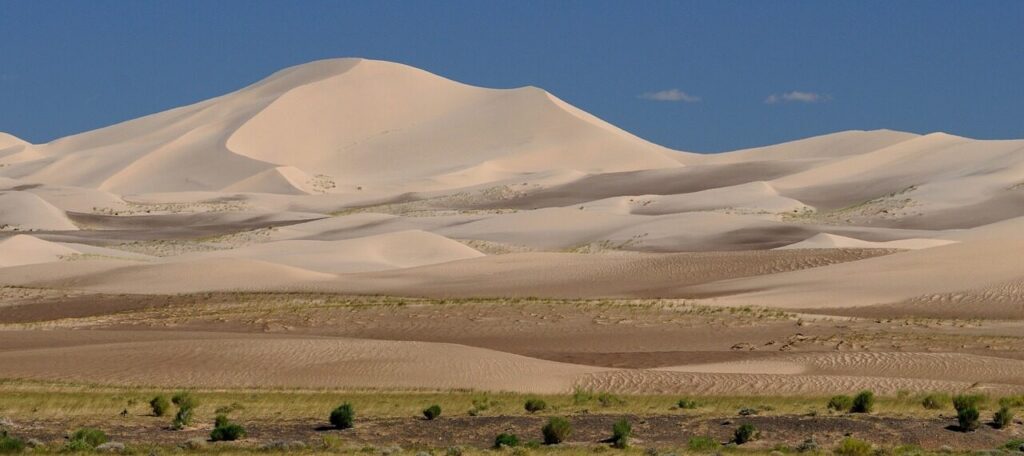
Standing at the edge of one of these man-made forests, you don’t feel the global carbon budget or the graphs from IPCC reports. You feel shade. You hear birds that weren’t there a decade ago. You notice that the village downwind has fewer days when the sun turns orange from dust.
Yet behind that very local experience sits a much bigger question: how far can humanity go in reshaping harsh landscapes to buy itself time in the climate fight? The Taklamakan experiment is part resilience, part risk, and part rehearsal for a future where engineered ecosystems become normal.
Other countries are watching closely. From the Sahel’s Great Green Wall to new projects in the Middle East, planners pick over China’s mix of bold ambition and hard lessons. Which practices protect soil carbon? Which end up wasting water? Which bring real benefits to people living on the edge of deserts, not just to national statistics?
There’s also a quiet shift in how we think about deserts themselves. For a long time, they were seen as dead space on the map. Empty, useless, available for grand schemes. Yet the Taklamakan has its own rhythms, its own hardy plants and nomadic traditions. Turning parts of it into a managed carbon sponge raises uncomfortable questions about what we label as “wasteland” and what we rush to “fix”.
*Not every dune needs a tree, and not every brown patch on a satellite image is a problem to be solved.* Some scientists now argue for more nuanced targets: protect natural drylands where they function well, restore only the parts truly damaged by overgrazing or mismanaged water.
The new forests, for all their promise, sit in this tension between repair and overreach
What’s happening in the Taklamakan ultimately circles back to everyday choices far from any desert. The idea that a once “dead” landscape can shift from dust source to carbon sink is both inspiring and a little dangerous. Inspiring, because it proves that large-scale ecological repair is technically possible. Dangerous, because it can tempt us into thinking we can always plant our way out of trouble while emissions keep rising.
It might be more honest to see these desert forests as a kind of climate savings account. Valuable, hard to build, easy to damage. They don’t replace the basic work of burning fewer fossil fuels. They sit alongside it, quietly taking in CO₂ while the world argues.
Next time a sandstorm in Asia is a little weaker, or a climate model shows a slightly stronger land sink over western China, part of the story will be those rustling poplars in a place once called the “Sea of Death”. Whether we learn the right lessons from them is still up for grabs.
| Key point | Detail | Value for the reader |
| Desert forests can absorb CO₂ | Planted belts in and around the Taklamakan now act as measurable carbon sinks | Shows that large-scale restoration projects can have real climate impact, not just symbolic value |
| Design matters more than big numbers | Species mix, water use and long-term care decide if plantations survive and store carbon | Helps readers judge future “tree-planting” announcements with a more critical, informed eye |
| Desert greening has trade-offs | Water stress, biodiversity loss and “green deserts” are real risks if projects chase speed over ecology | Encourages a more nuanced view of climate solutions, beyond simple “plant more trees” slogans |
FAQ:
- Is the Taklamakan Desert really absorbing CO₂ now?Some planted zones and shelterbelts around and across the Taklamakan are now measured as net carbon sinks, meaning they absorb more CO₂ than they release, though the desert as a whole is not a giant forest.
- How do trees survive in such a harsh desert?They rely on drip irrigation from groundwater and glacier melt, are planted in stabilized dunes, and use hardy, salt-tolerant species with deep roots and low water needs.
- Does this solve climate change for China?No. The carbon stored in desert forests is significant but small compared to emissions from industry and energy; it’s a helpful supplement, not a substitute for cutting fossil fuels.
- Are there downsides to planting so many trees in a desert?Yes. Overuse of scarce water, risk of monocultures, and disruption of natural desert ecosystems are serious concerns if projects are not carefully designed.
- Can other countries copy this approach?They can adapt parts of it, especially careful species choice and efficient irrigation, but each desert has its own climate, water and social realities that demand local solutions.
Original:https://beaconwales.org/23-164632-taklamakan-desert-that-it-co2/