admin
admin 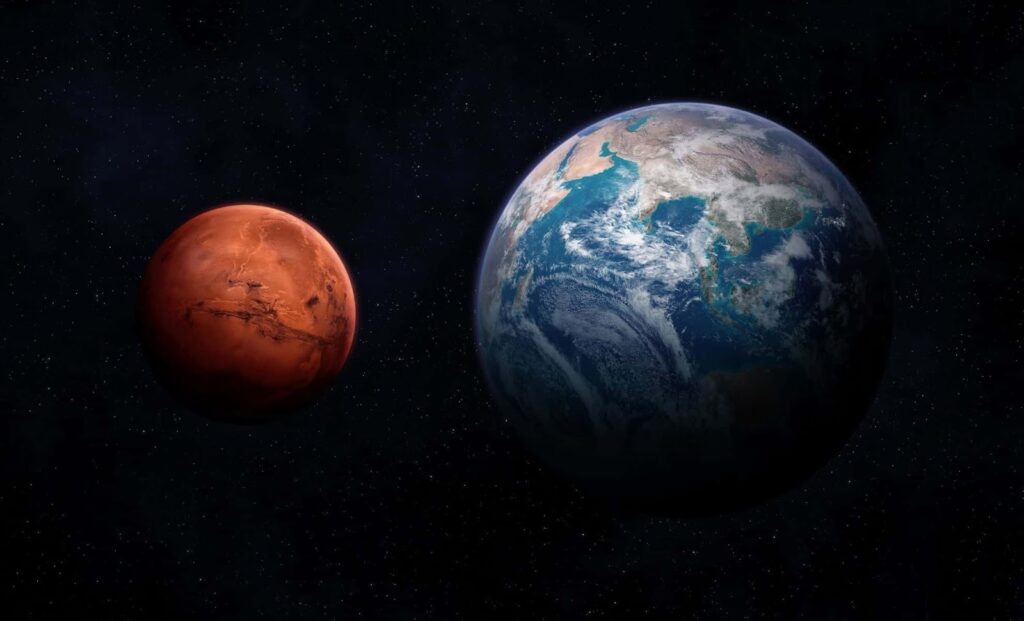
© Shutterstock
In a groundbreaking discovery, physicists at the National Institute of Standards and Technology (NIST) have calculated for the first time the precise difference in time between Earth and Mars. On average, clocks on Mars tick 477 microseconds faster than those on Earth per day. This knowledge will be crucial for NASA’s future missions to the Red Planet, as scientists look to synchronize communication and navigation systems across the solar system.
Slamani Aghilas
Published on December 2, 2025
The need to understand time on Mars comes as space agencies like NASA prepare for long-term human and robotic exploration of the planet. Since time behaves differently in different gravitational environments, thanks to Einstein’s theory of relativity, clocks on Mars won’t follow the same pace as those on Earth. This subtle but important difference in timekeeping can affect everything from communication to navigation systems, making accurate calculations essential for future missions.
The Complexity of Time on Mars
Determining what time is on Mars may seem like a simple question, but it involves far more complexity than you might think. According to NIST physicists Bijunath Patla and Neil Ashby, the key to understanding the Red Planet’ time lies in its weaker gravity compared to Earth’s. The surface gravity on Mars is only one-fifth as strong as Earth’s, which affects the passage of time. In stronger gravitational fields, like on Earth, clocks tick more slowly than in weaker fields. This effect, known as gravitational time dilation, is just one piece of the puzzle.
 Plots of the clock-rate offsets between a clock on Mars compared to clocks on the Earth and the Moon for ∼40 yr starting from MJD 52275 (2003 January 1) The Astronomical Journal
However, the Red Planet’ time is also influenced by its elliptical orbit around the Sun, which is more eccentric than Earth’s. Mars’ orbit varies significantly throughout its year, bringing it closer to and farther from the Sun. This causes fluctuations in the clock rate by as much as 226 microseconds per day. Unlike the Moon, which has a relatively stable orbital position and a predictable time variation of 56 microseconds, Mars’ eccentric orbit means time on the Red Planet is much more variable.
The Role of Relativity in Timekeeping
The difference in time between Earth and Mars is a direct consequence of Einstein’s theory of relativity, which shows that the strength of gravity and the velocity of a planet’s orbit both influence the passage of time. As NIST physicist Bijunath Patla explains, “The time is just right for the Moon and Mars. This is the closest we have been to realizing the science fiction vision of expanding across the solar system.” The calculations made by the NIST team are part of a broader effort to understand how timekeeping systems can be synchronized across vast distances, an essential component for reliable communication and navigation in space.
The moon, the Earth and mars orbit ©Shutterstock
NIST’s findings, published in The Astronomical Journal, provide a precise calculation of how much faster clocks will tick on Mars, at an average of 477 microseconds per day faster than on Earth. This knowledge helps pave the way for future space missions, where synchronization of time across planets will be essential for coordination between spacecraft, rovers, and ground stations on Earth.
Building the Foundations for Interplanetary Communication
Perhaps the most immediate application of understanding the Red Planet’ time is in the development of interplanetary communication systems. Currently, communication between Earth and Mars is delayed by anywhere from four to 24 minutes, a gap that could be improved if scientists can synchronize time across these two planets.
According to Patla, “If you get synchronization, it will be almost like real-time communication without any loss of information.” Achieving this level of synchronization would mark a major milestone in space exploration, enabling faster, more efficient communication systems between Earth and Mars, and potentially facilitating the creation of a solar system-wide communication network.
With NASA planning to establish a long-term human presence on the Red Planet, understanding how clocks behave in the Martian environment will be essential not only for communication but also for navigation systems. Just as GPS is vital on Earth, similar systems will be necessary on Mars. These systems will rely on accurate timekeeping to function properly. T
his is why NIST’s calculations of how time passes on Mars are so important. They provide scientists with the tools to begin developing the technology needed to navigate and communicate more effectively on the Red Planet.
Original:
Mars Time Mystery Solved! This is How Clocks Tick on the Red Planet