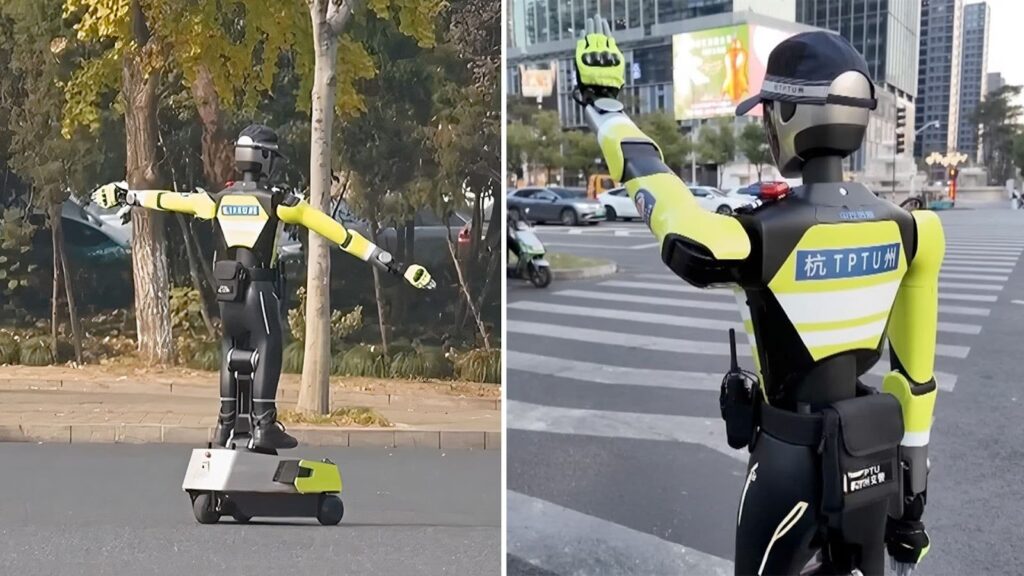
The wheeled robot uses AI to guide both pedestrians and vehicles.YouTube/CCTV
Violations are logged and sent to police, with an officer nearby to intervene if the robot’s polite warnings don’t work.
By AI and Robotics Dec 06, 2025 01:15 PM EST
A new AI-powered traffic robot has begun operating on the streets of Hangzhou, China’s tech hub, introducing a new chapter in urban automation.
Nicknamed Hangxing No. 1, the 1.8-metre humanoid now stands at the busy intersection of Binsheng Road and Changhe Road in the Binjiang district, where it directs traffic, detects violations, and issues polite voice warnings, according to Chinese media outlets.
In a city of nearly 12 million residents—many navigating at speed on motorcycles and in cars—traffic flow remains a long-standing challenge. The robot’s unusual appearance and role have quickly sparked curiosity and debate among locals.
In November, UBTech Robotics signed a deal with China to deploy Walker S2 humanoid robots along the Vietnam border, expanding the country’s public-facing robotics push.
AI intersection guardian
Hangzhou has begun testing a new AI-driven traffic robot, adding a futuristic presence to the busy streets of the Binjiang district. Hangxing No. 1, a humanoid-style machine developed by the Hangzhou Traffic Police Tactical Unit, began its pilot deployment on December 1 at the intersection of Binsheng Road, according to CCTV.
Standing at 1.8 metres tall and equipped with cameras, sensors, and gesture-based signalling, the robot is programmed to support human officers during peak movement of vehicles, scooters, and pedestrians. Its movements—including signals to stop, proceed straight, or wait—were modelled on real police officers, allowing it to mimic standardised command gestures. It can also sound a digital whistle and synchronise its instructions with the existing traffic-light network.
According to NotebookCheck, Hangxing No. 1 does more than signal drivers: it monitors compliance in real time. The system can detect common violations such as riders without helmets, motorists crossing stop lines, and jaywalkers. When it spots an infraction, the robot issues a calm, pre-recorded reminder designed to correct behaviour without confrontation.
Powering the machine is a swappable battery system that delivers roughly 6 to 8 hours of operation, allowing it to cover peak commuting windows before returning to a charging dock on its own.
Future traffic policing
Hangxing No. 1 operates under a tightly integrated software system that continuously monitors its surroundings. Cameras feed live images into an AI model that can spot issues such as vehicles edging past stop lines, pedestrians crossing red lights, or cyclists drifting into unsafe zones.
When a violation is detected, the incident is logged and forwarded to a police database. During the early stages of deployment, a human officer remains nearby, stepping in only when polite audio warnings fail to correct behaviour.
According to traffic brigade staff member Zhang Wanzhe, the robot’s decision-making improves over time. Engineers review rush-hour footage to refine its judgment and reduce false triggers—an issue noticed during initial October trials when shadows and wind occasionally confused the system, reports Techeblog.
Integration with Hangzhou’s City Brain platform gives the robot access to a wider urban network, enabling predictive responses—for example, sending alerts or adjusting behaviour if traffic signals fail nearby. Developers say nearly every component, from weatherproof casing to motion controls and the multilingual voice system, was built specifically for the robot’s role on the streets.
Officials say the robot will continue to refine its abilities through live data collected at the intersection. Future updates could integrate large language models, enabling them to answer questions, provide route guidance, or support public safety education.
Original:
https://interestingengineering.com/ai-robotics/china-deploys-humanoid-traffic-robot
 admin
admin