This article has been banned across the entire internet–Zhang Xuefeng: The Opposite of Idealism
 admin
admin 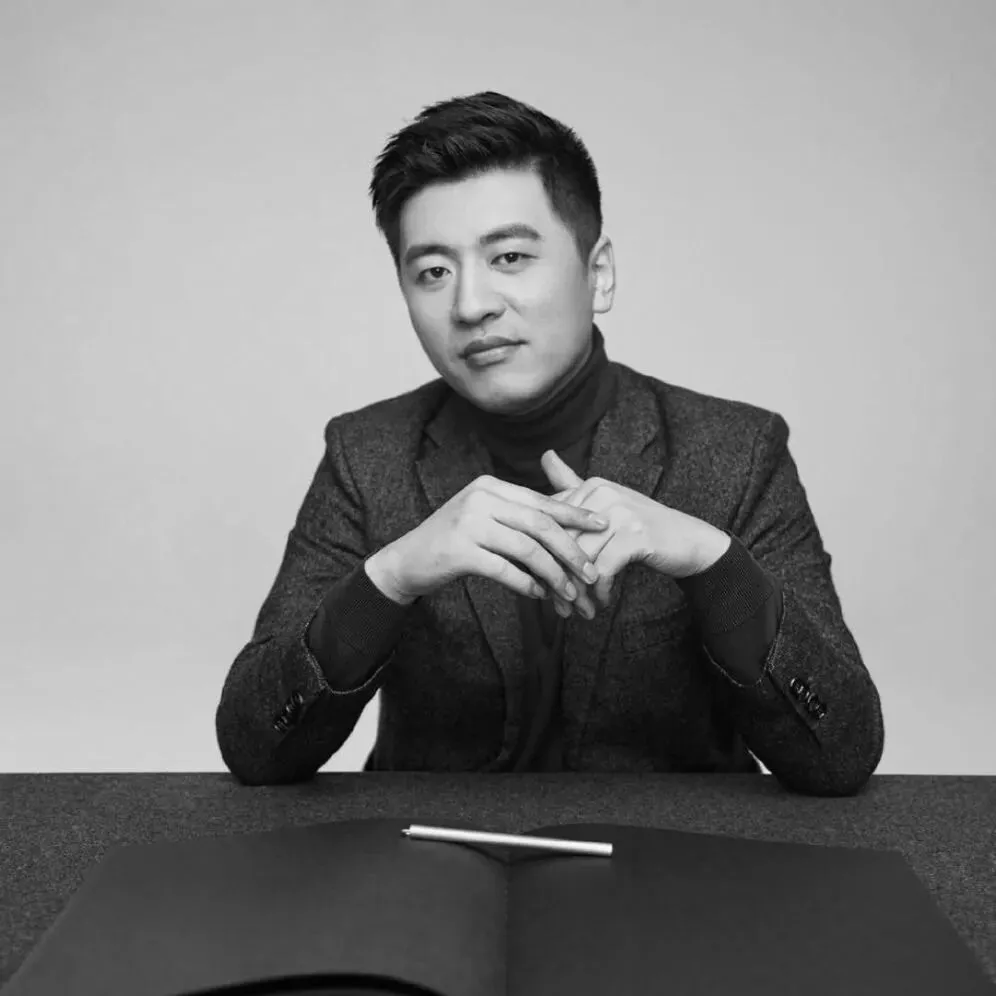
On March 24, 2026, Zhang Xuefeng died in Suzhou due to sudden cardiac arrest, at the age of less than 42.
By Feng Yingxing. Edited by | Osprey

The news spread online that afternoon, and many people still found it hard to believe until the obituary was published. His passing was so sudden; his last post on social media was from two days prior, March 22nd, the day he ran 7 kilometers. Throughout March, he ran almost every day, about 7 kilometers each time. Even before he left, he was still running. According to CCTV News, at 12:26 PM on March 24th, Zhang Xuefeng felt unwell after running at his company and was rushed to the hospital, where he sadly passed away.
The last ten years of Zhang Xuefeng’s life were incredibly busy. He traveled frequently for work, especially during the college application season, when he once went 40 hours without sleep to catch up on travel and give lectures. He consistently conducted high-intensity live streams, connecting with parents online, answering inquiries, and even selling products, often going four hours without stand up and move around or drinking water. He was known for his boundless energy. In 2023, a writer from *People* magazine worked with Zhang Xuefeng for a few days and witnessed his intense work schedule and irregular eating and sleeping habits. At the same time, he maintained an astonishing perseverance in running. In 2020, Zhang Xuefeng ran 3,000 kilometers and participated in his first marathon. Since then, he has run several marathons every year. Sometimes, he would run 12 kilometers in the early morning after a busy day. In his speeches, he often said, “If I can run over 40 kilometers, what can’t I do?”
Perhaps, in his view, continuing to run, and running faster, was the only option. Born in May 1984 in a county in Heilongjiang Province, Zhang Xuefeng came from an ordinary family. After graduating from Zhengzhou University, he worked as a postgraduate entrance examination tutor, remaining unknown until he unexpectedly became famous for interpreting videos of university applications. Afterward, he shifted his focus to college application services, a very narrow business that only served college entrance examination candidates and their parents for a short period of time. However, because the college entrance examination was given the meaning of “changing destiny,” Zhang Xuefeng achieved worldly success, establishing several companies. At the same time, his remarks were amplified infinitely.
He has repeatedly sparked controversy with statements such as “If my child insists on studying journalism, I’ll knock him unconscious!” and “Liberal arts is just a service industry.” Some believe he bridged the information gap, “revealing the truth about university and employment,” and changing the destinies of countless children from ordinary families. Others believe he is “utilitarian” and “attention-seeking,” simplifying complex educational choices into a single “job and money” approach, ignoring the people behind those choices. He always says, “Begin with the end in mind,” a methodology that is results-oriented and advocates avoiding detours—if busyness leads to success, then busyness is inevitable: On June 24, 2023, three days after the college entrance examination results were released, Zhang Xuefeng posted on Weibo, “Due to overwork, I have chest tightness and palpitations,” and he was forcibly hospitalized.
Like a reminder from fate, Zhang Xuefeng still pressed on. In the last three years of his life, his remarks frequently trended on social media, and his social media accounts were restricted from following others or suspended. He felt the overwhelming and uncontrollable force of public opinion and was learning to be more cautious in his words and actions. However, he still possessed a fiery and distinctive quality rarely seen in the Chinese internet sphere.
He once said in a live broadcast, “If I die one day, there will be a trending topic on major platforms called ‘Zhang Xuefeng is dead,’ meaning he might become a memory for a generation.” Like a prophecy, it came true. A generation, on their journey of exploring ways of life, will remember Zhang Xuefeng’s name, regardless of their attitude.
The departure of such a controversial figure in this way evokes particularly complex emotions. Behind the discussions and attention focused on Zhang Xuefeng lies the unmet need for guidance on college application choices among students and parents. And behind his success lies the yearning for stability and security among many people from ordinary backgrounds like his. Zhang Xuefeng’s sudden passing seems to be a stark reminder of this pursuit of certainty: even with as many certainties as possible, life still holds too many uncertainties. What’s next?
Someone once asked Zhang Xuefeng, “What would you write on your tombstone?” He replied, “Life is so much fun, I’ll come back in the next life.”
The following is a report about Zhang Xuefeng published by People magazine in 2023. This republication is a tribute to this intense, dramatic, and controversial figure.
“He’s become a professional apology taker.”
Zhang Xuefeng is already very familiar with the act of apologizing.
Throughout June, he trended on social media 16 times. The most sustained instance was when he advised a parent in a Douyin livestream that their child, who scored 590 on a science mock exam and wanted to apply to Sichuan University’s journalism department, “don’t let him study journalism even if you knock him unconscious.” This edited clip from a livestream six months prior went viral online, drawing repeated criticism from Zhang Xiaoqiang, a journalism professor at Chongqing University, who warned, “Don’t be fooled by internet celebrities like Zhang Xuefeng.” The two sides exchanged several rounds of heated debate, and even the slightest hint of trouble kept the topic trending.
Zhang Xuefeng now boasts over 20 million followers across various social media and short video platforms, often appearing as a “renowned postgraduate entrance exam tutor” and “college application advisor.” He’s passionate about expressing himself, sometimes posting six or seven times a day on Weibo, mostly simultaneously with his WeChat Moments. His three weekly live streams are edited into clips and distributed across different platforms, frequently stirring up public debate. Faced with a growing wave of criticism, he responds fervently, apologizing and softening his tone, yet his voice remains firm. “It’s like when you bump into someone on a bus and say, ‘Excuse me, I’m sorry, I’m sorry,’ are you really wrong? It’s just a matter of manners.”
After trending again for complaining about a friend paying 600,000 yuan in mortgage interest and 570,000 yuan in interest, Zhang Xuefeng faced criticism for the inaccuracy of his data. He then created a “I was wrong, I apologize” T-shirt and started selling it on his livestream. “The husband buys it to wear for his wife to see, while the man buys it to wear for his girlfriend to see.” he said. “I’ve become a professional apology performer.”
Public opinion on Zhang Xuefeng is sharply divided. Supporters call his advice on choosing a major and filling out college applications a “pragmatic guide,” saying it “breaks down information barriers for those at the bottom” and “tells the truth about university and employment.” Critics, on the other hand, dislike his absolute language style, which is perceived as “clickbait” and “attention-seeking.”
He responded, “I come from an ordinary family. If you come from a wealthy family, you have more choices, and there is no question of right or wrong! But for most families, the conditions are not so good. When choosing a major, you should choose one that suits you and can make a living, instead of just following the textbook!” This time, he received a flood of resonance from “ordinary people” online.
He had mixed feelings about the increasing internet traffic.
When I met him at the Fengxue Weilai office building in Suzhou Industrial Park at the end of April, there was almost no small talk. He immediately launched into a long explanation of the monetization model of a comedy video influencer—this influencer had over 100 million followers across the internet and had repeatedly topped the live-streaming e-commerce charts on video platforms. “You really should interview him,” Zhang Xuefeng said. Many fake accounts distribute clips from these top influencers’ live streams, then add them to shopping carts to make a considerable profit. The original streamers turn a blind eye, “Let them run on their own first, and then we’ll talk about collaborations once they reach a certain scale.”
This same pattern has also appeared with Zhang Xuefeng. Video platforms are flooded with clips of him, and he frankly admits that he only truly owns “one” account. These accounts, which are subordinate to his online traffic, have accumulated nearly a million followers in some cases, and he sees them as part of a traffic amplifier.
“You’re very lenient with them,” I said. “Even indulgent,” he immediately corrected.
One day in mid-May, he said again, “I really hope Weibo removes me from its platform.” He vaguely sensed the uncontrollability of public opinion on social networks. “What I say is one thing, how you write it is another, how netizens interpret it and how they stir up trouble is yet another—it’s completely uncontrollable. If I didn’t rely on online traffic to support my family, it wouldn’t matter at all!”
He believes the biggest misunderstanding about him is his “utilitarian” approach, citing the debate over whether or not to study journalism as an example. “It has to be admitted that 80% of students studying journalism and communication don’t end up working in the field,” he says. In his view, everyone is a self-media outlet, meaning that job opportunities for university journalism graduates are shrinking. “If a student tells me they absolutely must work in media, that they have this dream, I would also suggest they study Chinese language and literature instead of journalism and communication. Even if they don’t get into media, wouldn’t their career paths and job opportunities be more plentiful than those of students who study journalism?”
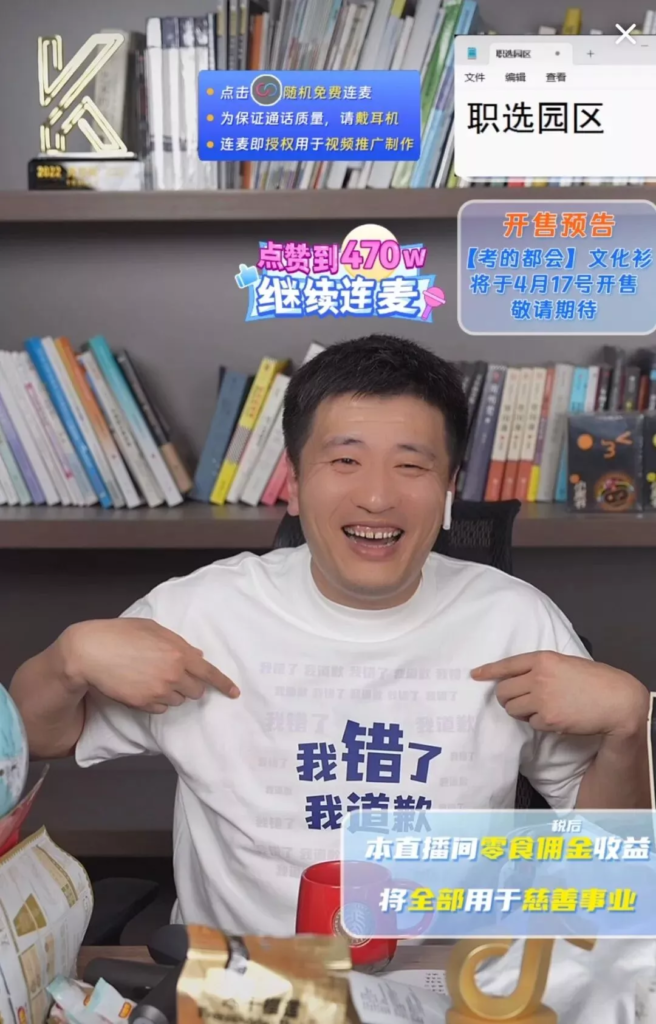
Screenshot of Zhang Xuefeng’s live stream
The starting point of his sudden fame
Before the summer’s explosive popularity, Zhang Xuefeng had already been a popular figure online for seven years.
The “explosion” happened almost overnight. He didn’t even know where the famous video was recorded, “maybe in Chizhou.”
In early 2016, Zhang Xuefeng left the postgraduate entrance exam preparation institution he worked for and founded Yantu Postgraduate Entrance Exam Preparation Center with a friend. He doesn’t teach any subjects; he only guides students in choosing postgraduate majors and universities. Initially, things didn’t go smoothly. “There was almost no business, and we were on the verge of going out of business.”
A friend burned his speech onto a CD and took it to a more remote university to play it. Someone got hold of the video, cut out a segment, and uploaded it online. That video, titled “7-Minute Explanation of Universities with Independent Admission Scores,” along with another video, “A Quick-Tap Narrated List of China’s Top Universities in Half a Minute,” was captioned “His Speaking Speed Rivals Hua Shao’s,” and quickly went viral online. Zhang Xuefeng woke up one morning to find “the whole world had changed.” He even began to wonder: “Should I go back to stand-up comedy or continue trying to save students?”
The immediate joy was immense. The company, which was “on the verge of collapse,” was “instantly revitalized.” He changed his Weibo account to “Teacher Zhang Xuefeng,” and his followers “gained 100,000 every day, 100,000 every day.” A week later, anxiety followed. “500 a day, then 200 a day after that, and two months later, the wave was over.” The number eventually settled at 7 million. The slowdown in follower growth became “the most terrifying thing” for him, and he “just kept thinking about how to keep himself popular.” He started trying to make new videos, do live streams, and even live streamed a Q&A session on his daughter’s birthday, trying everything, “but nothing worked.”
He appeared on variety shows, participated in “Weird Conference“, and acted in movies, building a wider social network and accumulating more “trending” energy. At the open audition for “Weird Conference“, his speech, titled “I’m an Internet Celebrity, Is It Wrong to Want to Trend?” recounted his overnight fame. Cai Kangyong asked him, “Have you always spoken this fast?” Zhang Xuefeng smiled slyly, “Mr. Kangyong, you might not know, but in China, there’s a place called Northeast China. In winter, it’s very cold outside, and you can’t go outside; you can only stay indoors and brag. You’ll be like that after a few months.” This drew laughter from the audience. He also talked about his extreme goal-oriented nature, citing as an example: “I set a goal: I must get married before I turn 30. The wedding date was set, but 40 days before the wedding, I changed brides. From meeting the new bride to getting the marriage certificate, it took 45 days.” He still aimed for the sensational.
“Weird Conference” is a forum for the clash of diverse values. Compared to other “oddballs,” Zhang Xuefeng’s traditional values seem somewhat out of place. He said, “A man has no self. The best state is to make your parents think they have a good son when you’re 25, make your wife think she has a good husband when you’re 35, and make your children think they have a good father when you’re 45.” Xiao Xiao questioned his pragmatism: “His idea of a good life is different from mine. His idea of a good life is the good life for most people, and I can’t accept that.” Zhang Xuefeng retorted, “I just want to buy a house and a car in my city. Is that too much to ask? I want my wife and children to have what others have. Is that too much to ask?”
When I met him offline this time, he was more wary than he was seven years ago. He pessimistically predicted, “The end for all internet celebrities is their downfall.” He doesn’t know when that moment will come. Now, he can only try his best to prepare a Plan B.
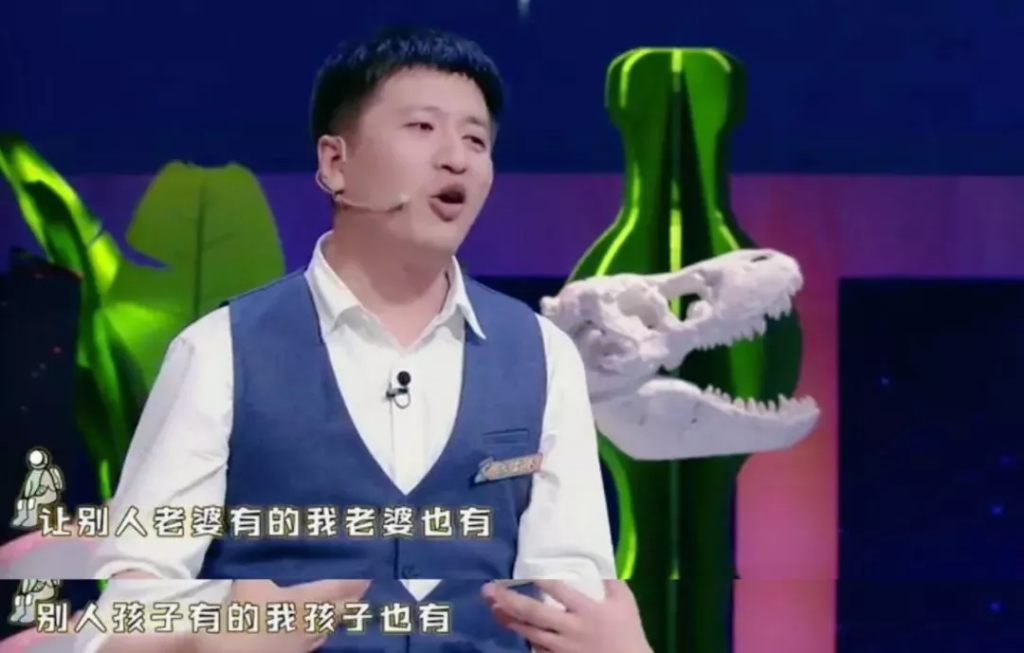
Zhang Xuefeng’s speech on the show “Weird Conference” (Image source: Internet)
“Spend 10,000 yuan to decide your child’s life.”
On the day of my visit, I followed Zhang Xuefeng’s entire live stream. He appears in the live stream room on time every Monday, Wednesday, and Friday, broadcasting three times. His employee, Wu Liang, reminded me, “You’d better get some rest beforehand, otherwise you won’t be able to handle it.”
To outsiders, he was known for his boundless energy. That day, our interview with *People* magazine lasted from 10 a.m. to past 2 p.m., during which I suggested, “Why don’t you grab some lunch?” He declined. The interview was finally interrupted by his assistant’s reminder that he had to participate in a recruitment livestream in the industrial park. He continued his high-intensity output for over an hour, and as dusk fell, he returned to the company. At 7:00 p.m., the students’ parents were already waiting for him in the live stream room.
Within 20 minutes, over 30,000 people had flooded into the live stream. After a brief exchange of pleasantries, the live stream connection began. Two bright lights shone directly on him, and Zhang Xuefeng immediately became excited: “Like, like, like! If we get 200,000 likes, we’ll connect!” A chubby boy huddled in a corner, staring intently at the control panel, afraid to make a sound. The conversation began with a parent’s exclamation: “Oh my god, I actually connected! Teacher Zhang, I’m so happy!” “Which province are you from?” “Arts or Science?” “Subject selection?” “What score can you get?” The student was quantified into coordinates and data. Having obtained this basic information, he would interrupt the parent almost immediately, giving the answer with a resolute tone, before the parent could even finish speaking.
During his live stream that day, he desperately tried to persuade a parent to enroll their daughter in dental school, “but she thinks other people’s mouths is dirty,” the girl’s mother said. Zhang Xuefeng then grabbed a handful of snacks in front of him, held them to his chest, and, “Let’s say this is money,” tossed the snacks onto the table one by one. He then asked the parent, “Just ask her, is it dirty?”
Sometimes, when parents’ statements contradicted his opinions, he would suddenly raise his voice: “You need to predict what the permanent boom will be! Can you live without communications? Can you live without information transmission? Can you live without chips? Can you live without the internet? You can’t! You need to think like this when choosing a university!” After several parallel sentences, his speaking speed unconsciously increased, and he continued to raise his voice, “Some people say, ‘Teacher Zhang, I can’t live without rice, flour, and oil,’ but you need to remember one thing: whether something is valuable or not, the key is what? Added value. Added value, understand? Added value! Come on, everyone, type these three words in the chat!”
After a torrent of comments, the atmosphere in the live stream reached its peak. The chat was flooded with messages, and the number of viewers remained at 40,000. All night, the chat entry kept displaying the message “The maximum number of viewers has been reached.” Behind these numbers were almost exclusively parents of students. Some people left after waiting too long to connect. Zhang Xuefeng reconnected and said “hello” a few times, but there was no response. “You know, we also call this the ‘Hello Hello Hello’ live stream,” he excitedly introduced to me, sitting off-camera.
That evening, Zhang Xuefeng livestreamed for a total of 234 minutes, without getting up or drinking a drop of water, for nearly four hours straight. On average, he answered a parent’s question every six minutes. He connected with other viewers, answered inquiries, encouraged fans to like his posts, interspersed with product sales and snacking, then continued connecting with other viewers in a continuous cycle. The door to the livestream room was open, and his dog, Ice cream, wandered inside and outside the room. Sometimes, Zhang Xuefeng would call out, and a staff member would hand Ice cream over, which Zhang Xuefeng would then bring in front of the camera and make it bow to the viewers.
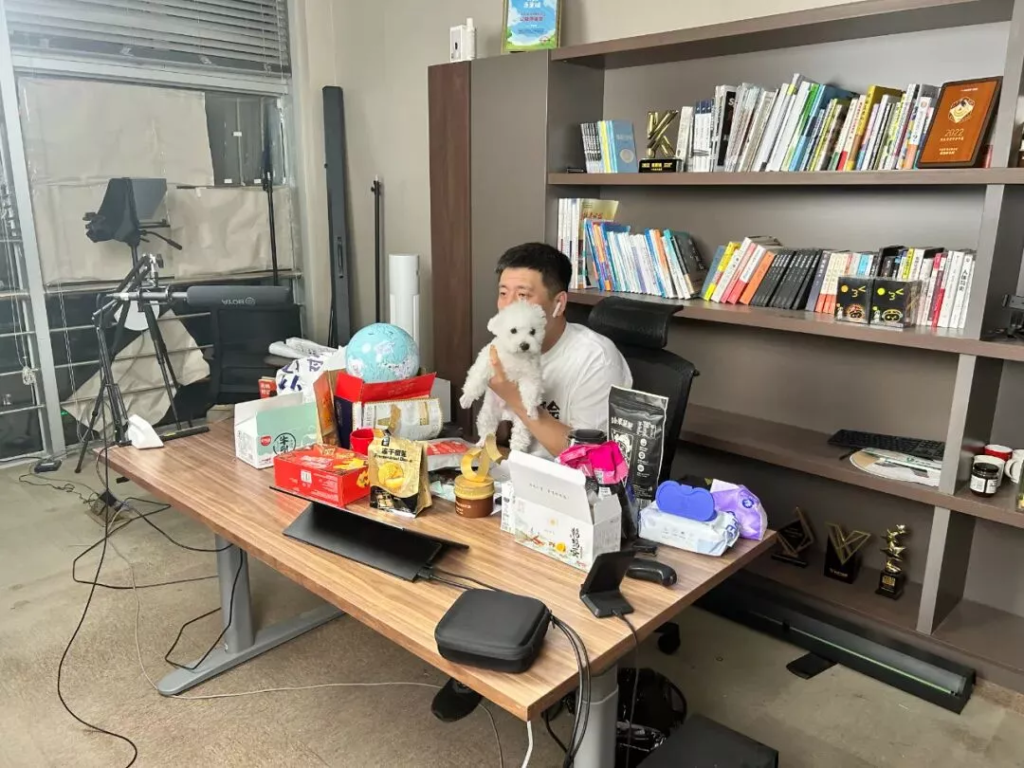
During the live stream, Zhang Xuefeng brought the puppy in front of the camera. (Image source: Feng Yingxing)
Without any guidance, he could single-handedly manage the entire live stream. The live stream room was the heart of the storm; anxious parents, an excited Zhang Xuefeng, and the barrage of fan badges and comments flashing by in seconds created a frenzy. The ambient lighting and the heat emanating from the people in the live stream room made it noticeably hotter than elsewhere. Outside the live stream room, the hundreds-of-square-meter office was empty, half-lit. At the row of workstations closest to the live stream room, several employees stared intently at the screens, tension radiating from their furrowed brows. They were each in charge of managing the changing light boards on the live stream and the constant influx of back-end inquiries.
The updated signboard highlights Zhang Xuefeng’s product: college application assistance. With the college entrance exam approaching, a product costing nearly 10,000 yuan has become a bestseller. This is a dedicated link for college application services specifically for high school seniors. His company, Fengxue Weilai, has employees who simulate students’ scores before the exam, planning the universities and majors they can apply to. Once the scores are released, they immediately select the “optimal combination” from over 1,000 universities and 500 majors, ensuring the student’s success.
Zhou Hang (pseudonym) once worked as a customer service representative for Zhang Xuefeng’s livestream. June is the “peak season,” and inquiries surged. “A single night of livestreaming can generate 10 million (in sales).” This means that at least 1,000 orders can be placed during those few hours of livestreaming. Zhang Xuefeng interspersed different links in the livestream, and a large number of inquiries flooded the backend. The customer service representatives prepared frequently asked questions in advance, made slight modifications, and immediately replied to the parents who came to inquire. “If we reply even a little late, the popularity will drop,” “Some people only ask for two minutes and then immediately place an order, and many others place an order without even asking a question.”
“For those parents, spending 10,000 yuan to decide their child’s life is something they don’t hesitate to do,” Zhou Hang said.
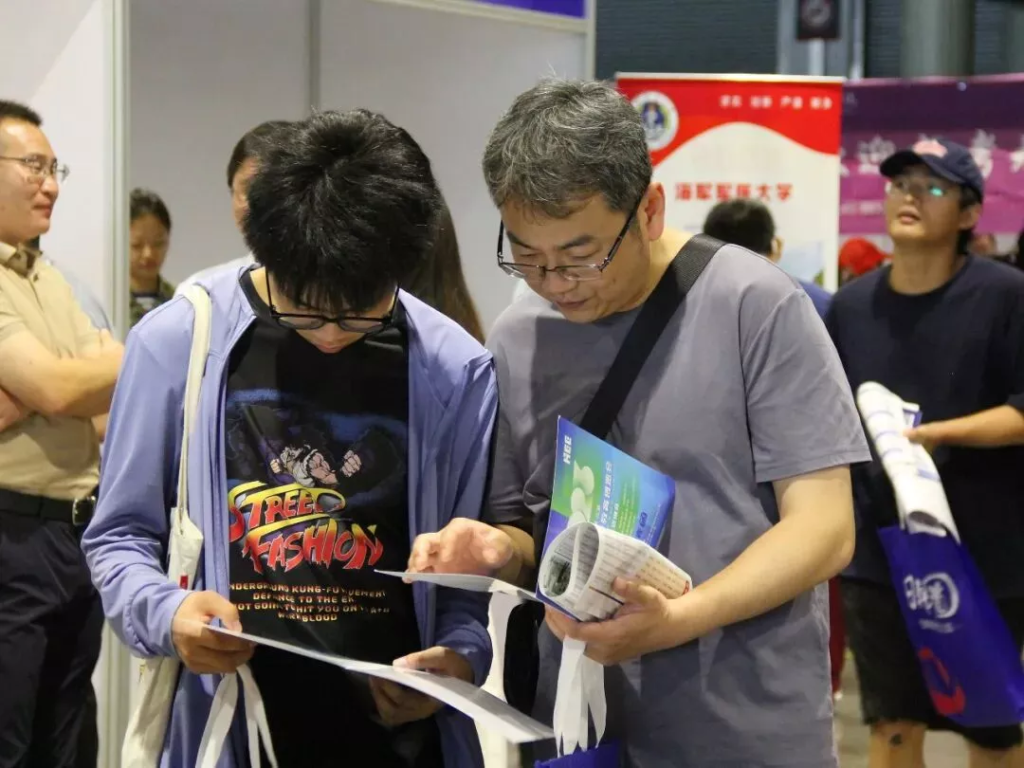
This year, the first college admissions application consultation fair held at the Nanjing International Exhibition Center attracted students and parents. (Image source: Visual China)
“Even without Zhang Xuefeng, there would be Wang Xuefeng or Li Xuefeng.”
Before this college entrance examination season, many people’s perception of Zhang Xuefeng was still limited to “a teacher who teaches postgraduate entrance exams.” In fact, since 2021, when Zhang Xuefeng made a high-profile departure from Beijing and moved to Suzhou in the same way that dominated Weibo’s trending topics, his main profession has quietly changed.
In Suzhou, he owns a company he fully controls, Fengxue Weilai, which mainly focuses on college application assistance. Over the past three years, the product line has been continuously expanded, and services have been extended to both ends of the college entrance examination process, covering multiple links such as subject selection in the first year of high school, college planning guidance, and internship arrangement.
Zhang Xuefeng explained this shift in business direction as “sensitivity to policy.” He sensed new business opportunities amidst policy changes.
On September 4, 2014, the State Council issued the “Implementation Opinions on Deepening the Reform of the Enrollment System,” signaling the full launch of the new college entrance examination reform. This is the most comprehensive and systematic reform of the college entrance examination system since its resumption in China. The new college entrance examination breaks away from the previous division between arts and sciences. In addition to the three compulsory subjects of Chinese, mathematics, and English, students can actively and randomly choose six subjects: politics, history, geography, physics, chemistry, and biology. This model is called the “3+3 model.” Shanghai and Zhejiang were selected as the first pilot areas, and this model was first implemented starting with the first-year high school students entering in 2014.
In 2017, the first batch of students using the “3+3 model” entered the college entrance examination hall. The number of candidates in different subjects showed the disparity in students’ subject choices—nearly 70% of students abandoned the more difficult subject of physics in order to pursue a higher total score in the college entrance examination.
Therefore, starting with the eight provinces that launched the new college entrance examination reform in 2018, the “3+3” model was adjusted to “3+1+2”. Chinese, mathematics, and foreign languages are compulsory subjects, physics and history must be chosen from two subjects, and then two subjects can be chosen from the remaining four subjects.
The scope of the new college entrance examination has been continuously expanding. By 2023, 29 provinces across the country had launched the new college entrance examination reform. The way college application is filled out has also undergone significant changes.
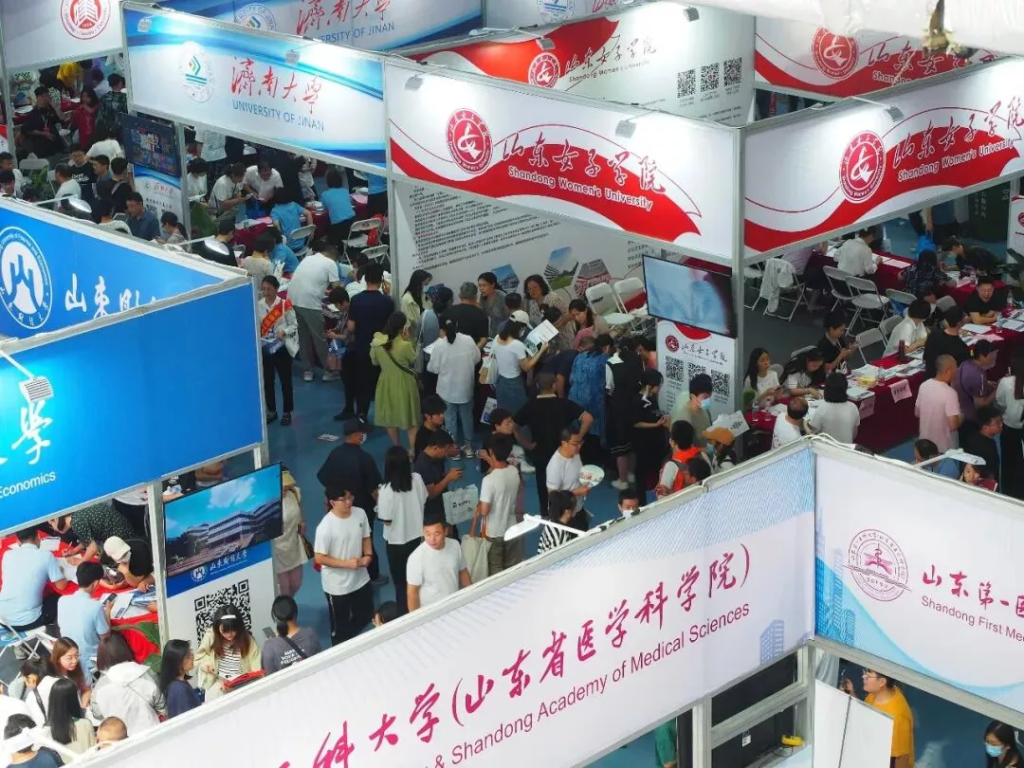
The 2023 Shandong College Entrance Examination Admission Consultation Fair featured booths from over 500 universities.
In 2017, when the first batch of students taking the new college entrance examination stepped out of the examination hall and began filling out their college applications, they suddenly realized that the subject choices they made in their first year of high school were directly related to their choice of university major. Each combination of subject choices corresponded to a different list of universities and majors.
For example, if a student chooses physics and chemistry but not biology as their college entrance exam subjects, they will be unable to apply to many universities for clinical medicine. If they did not choose physics, a student aspiring to be an engineer will also be unable to apply to engineering programs, including mathematics, materials science, mechanical engineering, and electrical engineering.
“He didn’t choose the right subjects, so he can’t study some of the majors he wanted,” Zhang Xuefeng said. This forces parents and students to “think about many things from the very beginning of high school, such as where they want to work, what majors they should study, and what jobs they can do.” He encourages students and parents to plan ahead, saying, “The four most difficult majors (biology, chemistry, environmental science, and materials science) and medicine are destined to require postgraduate studies, so you need to prepare early.” His statement in the live stream, “You can start preparing for postgraduate entrance exams as soon as the college entrance exam is over,” was edited and widely circulated. Zhang Xuefeng once again became a trending topic.
In different provinces, the new college entrance examination and the old college entrance examination are running concurrently. In provinces implementing the new college entrance examination, the application process is divided into two different models: “major + university” and “major group + university”. Many parents and students are confused about how to distinguish between these models and the old college entrance examination’s “parallel application”.
Essentially, the “major + university” model is changing the previous “university priority” principle in college admissions, and instead guiding students to pay more attention to their chosen major. However, in reality, due to the lack of vocational education in secondary schools, the mismatch between university majors and actual employment opportunities, the increasingly difficult job market for undergraduates, and the increasingly competitive postgraduate and civil service exams, parents and students are becoming more and more hesitant about choosing a major and are seeking more certainty.
In the new college entrance examination’s “major + university” application model, each combination of major and university counts as one application. For example, Communication Engineering at Beijing Jiaotong University and Electrical Engineering and Automation at the same university count as two applications. A typical student can submit a maximum of 96 applications based on these different combinations. The situation in Liaoning is more complex, with a maximum of 112 applications per student. Even professional college application advisors find it challenging to apply to students from Liaoning.
Ma Zhiyuan, a college application consultant at Fengxue Weilai, said that for the past three years, he and his colleagues have repeatedly explained to parents what subject selection is, what the new rules for college application are, which schools and majors different subjects might correspond to, what the specific differences are between seemingly similar majors, and what the corresponding job opportunities are. Countless times, Ma Zhiyuan spent hours explaining to parents until his throat was dry, only to look up and see that the parents’ faces were still full of question marks.
More often than not, their job is to solve a ranking problem: “How do I choose between Chongqing University of Posts and Telecommunications, Xi’an University of Posts and Telecommunications, and Guilin University of Electronic Technology?” “Xi’an University of Technology, Tianjin University of Technology, Zhejiang University of Technology, Guangdong University of Technology… these schools have similar cut-off scores, how do I choose?” Not all students have the opportunity to attend prestigious universities, and there are huge information gaps among these different cities and less well-known universities. The application period for colleges and universities varies from three days to two weeks, and few people can grasp so much information about universities and majors in such a short time. Many children from ordinary families “blindly fill in a blank like the blind men and the elephant.”
The expansion of the National College Entrance Examination (NCEE) has also brought more room for imagination to this industry. Data from the Ministry of Education shows that in 2023, the number of applicants for the NCEE nationwide reached 12.91 million, an increase of 980,000 compared to the previous year, marking a record high.
“Even without Zhang Xuefeng, there would have been Wang Xuefeng or Li Xuefeng to fill this role,” Wu Liang said. And Zhang Xuefeng appeared at just the right time. He seized the opportunity precisely.
His sensitivity to client needs and opportunities can be traced back to June 2016, the time when he had just become an online sensation. He received many private messages, with many people consulting him about college application strategies. He wrote on Weibo: “College application is not my main job. I’m just giving you some advice based on my understanding of schools! If there are serious consequences, don’t curse my ancestors for eighteen generations!”
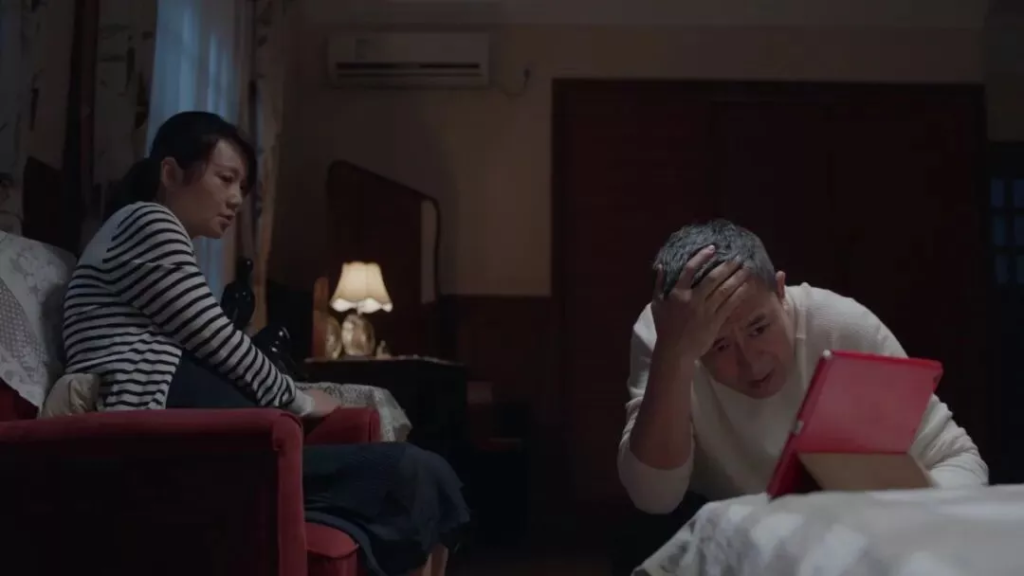
Image source: TV series “Growing Pain”
“The biggest difference between people, besides academic performance, is their family background.”
“Do you want to make money or find stability?” “What are your family’s financial situation like?” “Can you provide support for your child?” These are questions that teachers at Fengxue Weilai will definitely ask parents. Different questions point to different solutions.
The answers to these questions, along with the candidate’s province, chosen subjects, and scores, were quantified into data points and coordinates corresponding to different city tiers and chosen majors. Some have summarized Zhang Xuefeng’s application strategy: STEM majors have high job placement rates, while humanities majors have low rates; he encourages humanities students to focus on “law, accounting, and Chinese language and literature,” calling them “majors with professional barriers,” as these three majors have a higher recruitment rate in civil service exams—”I can do it because I studied it, and you can’t because you didn’t. That’s called a professional barrier”; for those with strong math scores, computer science and mathematics are top choices; for those without strong family backgrounds, he advises against studying finance, “because it’s very dependent on family wealth”; and for doctors and lawyers, alumni associations are their best local resources—”generally, it’s best to stay and work where you studied.”
However, few “clients” can give a direct answer regarding whether to prioritize making money or stability. “You can only choose one,” says Wu Liang, a college application consultant at Fengxue Weilai. When he presses him further, he points to a pattern: “All parents want stability, but all children want to make money.”
They discourage children from ordinary families from pursuing “stability,” and interests are rarely emphasized here. “If a child from an ordinary family says he loves archaeology, how can he prove to you whether it’s a skill or just an imagined hobby? I would advise him to go and try digging in the scorching sun for an afternoon first.” Ma Zhiyuan’s way of speaking has already inherited Zhang Xuefeng’s style.
Every year, Ma Zhiyuan personally serves more than 50 students. He summarizes his application methods into four points: “subject, personality, family, and grades.” If these factors are fully broken down, they point to a series of empirical observations from “veterans”: “If your math and physics are relatively weak, studying engineering will definitely be difficult. Even if you study engineering, you will find that you are not really good at it when you take the postgraduate entrance exam, because the postgraduate entrance exam for engineering requires math; if your child has a strong desire to make money, then you can’t let him study marketing, because marketing graduates are all salespeople with the lowest barriers to entry. You should let him study electrical automation and become a salesperson who sells equipment worth millions.” Families should also be divided into three categories: ordinary families should aim to make money because their “tolerance for error” is low. “You have to be able to support yourself first and find a decent job after graduation. Children from middle-class families can pursue their interests.” As for the definition of a middle-class family, “You can at least buy a house and a car for your child in a city like Suzhou, or send them abroad for graduate studies. In medicine, biochemistry, environmental science, and materials science, it’s meaningless without graduate studies. But if you have a large and wealthy family, any choice you make is correct. But all of this is in vain without achievements.”
Zhang Xuefeng put it more directly: “The biggest difference between people, besides academic performance, is their family background.”
Tens of millions of netizens flocked to him, and even more parents formed an alliance with him. “When children need to go to school, it’s all parents who come to register,” Zhou Hang said.
The “customers” who made purchases in the live stream moved to the execution level. Fengxue Weilai’s application consultants took over, dividing them into four large groups based on their province of origin, and began more intensive communication with parents. This job was not easy. In the first year, they only attracted a little over 400 parent clients.
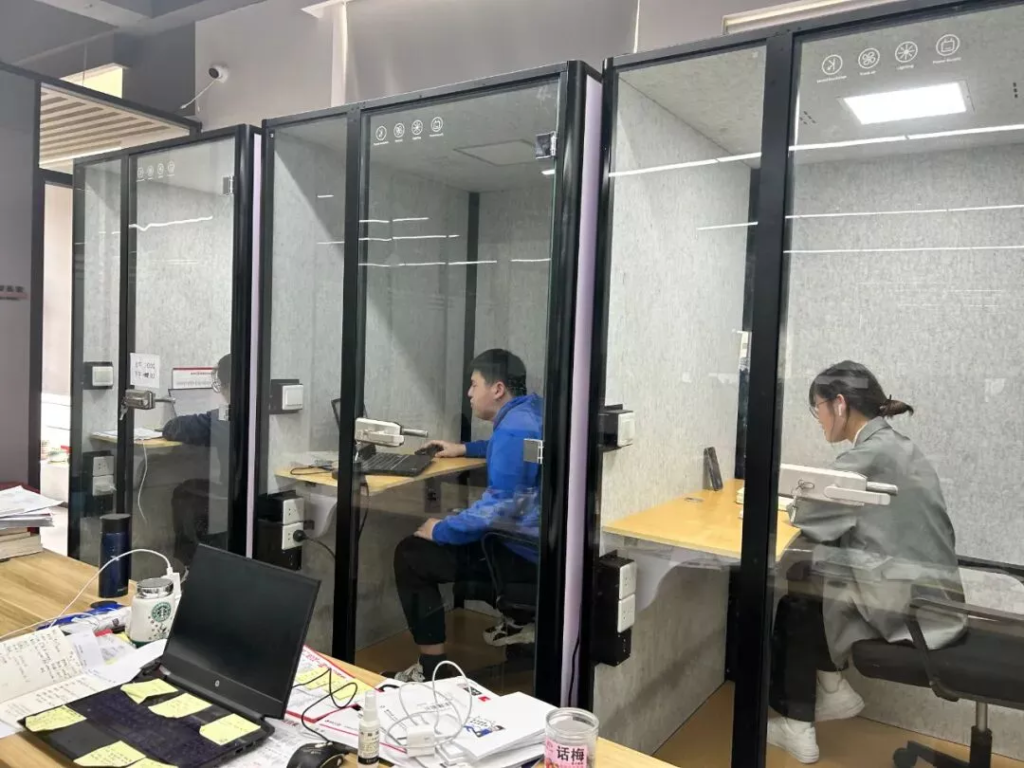
NIO employees can start live streaming from their cubicles at any time. (Image source: Feng Yingxing)
On June 22 of that year, as college entrance examination scores were released one after another, Fengxue Weilai entered the peak of the year’s application period. Zhang Xuefeng rented a four-star hotel, where all the teachers applying for the college entrance examination stayed and began a closed-door application process. Their sleep was reduced to two hours a day, which continued until the application system closed.
During those days, parents became even more frantic. In some provinces, the application window was only three days long. While Wu Liang was in the bathroom, a parent on the other end of the internet started yelling at him: “I’m in such a hurry, and you’re still in the mood to take a dump!” The pressure on the application teachers also reached its peak. After the application period ended, Wu Liang saw a colleague crying in the elevator.
Many people left, but Zhou Hang was one of those who persevered. Over the past few years, watching the number of applicants for Fengxue Weilai’s college application services increase from 400 to 5,000—a 12.5-fold increase—he felt he had entered a rapidly rising market. He used to work as an agent for a postgraduate entrance exam preparation agency in Anhui, a colleague of Zhang Xuefeng. Entering the college application industry, his most direct feeling was that the customer base had changed dramatically compared to postgraduate entrance exams; persuading parents was much easier than persuading students. “Everyone wants a definite answer; no parent wants their child to have a difficult future.” As clips of Zhang Xuefeng’s videos circulated online, the concepts of “information asymmetry” and “different fates for the same score” permeated the minds of many parents.
Helpless moments often occur. Zhou Hang is in charge of the Hebei region. Every year, at least 40 parents will say to him, “Teacher Zhou, could you reserve a spot for me? I’ll save up my salary for the next two months and give the money to you.” Most of them come from rural areas, and “I can directly feel their dedication to their children and their helplessness.”
While short video platforms attract users indiscriminately, the majority of “customers” exhibit a concentrated demographic. Wu Liang observed that among the parents who paid for Fengxue Weilai’s college application services in recent years, those from rural areas are still a minority. “After all, the price barrier inherently segments the population.” Parents from second-, third-, and fourth-tier cities are the most numerous. These parents often have stable jobs, “mostly doctors or civil servants within the system, and they are more likely to want their children to leave their cities.”
From a provincial perspective, students in Beijing and Shanghai have very little demand for this type of consultation, as their pathways to higher education are often broader. Jiangsu, Heilongjiang, Shandong, Henan, and Hebei are the provinces with the most consultations. Different application preferences also emerge among the provinces: parents in Shandong prefer stability, students from Jiangsu, Zhejiang, and Shanghai rarely “go out,” and parents in Hebei prefer to travel along the Beijing-Shanghai high-speed railway, “perhaps for convenience when returning home.”
When faced with certain problems, they exhibit almost the same struggle and confusion: “When choosing between a minor language or philosophy major from a 211 university and a law major from a non-211 university, before the scores are released and applications are submitted, they all know to prioritize the major. Once faced with this choice, they will all choose to apply to a 211 university.” “No matter how we try to persuade them, it’s no use. They just agonize over it, and at the last moment, it’s like drawing lots, and they hastily fill in a major.” Wu Liang often feels helpless. He says, “After all, we are essentially a consulting company, right?” Ultimately, the decision still has to be made by the parents and students themselves.
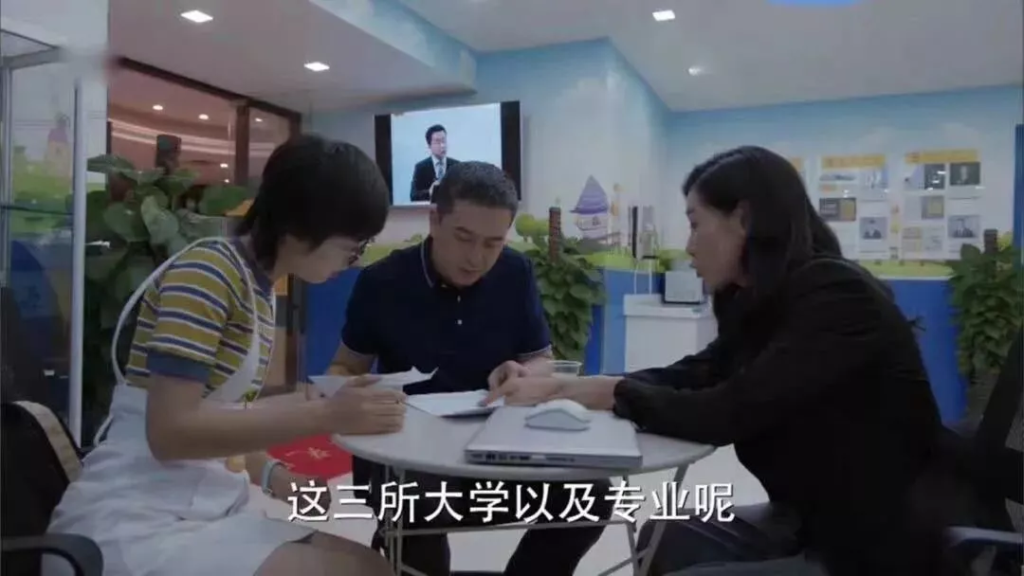
Image source: TV series “Growing Pain”
“People’s sense of purpose will only become stronger.”
In Zhang Xuefeng’s live broadcast, one phrase was repeatedly mentioned: “Begin with the end in mind.” This is a results-oriented methodology. “If you know the destination, why take a detour?” The corresponding practical guidance is: “If your goal is to become a teacher in a county in Henan, then go to Xinyang Normal University. That’s enough. Don’t try to get into Beijing Normal University or Capital Normal University.” He believes that most people’s lives can be planned. People like him who can achieve breakthroughs from the bottom are a minority. What he wants to do is “tell the story of how most people become swans.”
He also observed that in recent years, the admission scores for what he calls “professions with professional barriers” have risen sharply, with majors such as teacher training colleges and Chinese language and literature seeing their scores increase by tens of points. “People’s goals will only become stronger and stronger.”
“Wouldn’t it be more groundbreaking for the child who insisted on choosing what their heart desired despite your objections?” I asked.
“No. Can an industry be changed by one’s ideals?” he answered decisively.
He often mentions the story of “a glass of wine,” which happened during his previous entrepreneurial venture: “I’m allergic to alcohol. An investor asked me to drink, promising to invest in me if I drank that one glass. Would you drink it or not?”
Zhang Xuefeng was born in 1984 in Qiqihar, a small county with a population of only 140,000. He ranked 60th in the county in the college entrance examination and was admitted to Zhengzhou University to study water supply and drainage. “That was not my first choice.”
He said he used to be a “troublemaker,” and during his university years, he “did everything except murder and arson.” His dream used to be to be a host, but during a hosting competition, someone noticed the brand of his suit and realized that he was not worthy of that dream. “My idealism was gone.”
After graduation, he did not pursue his major like most of his undergraduate classmates. Instead, he plunged into Beijing, struggled and experienced many years of the sardine-can-like subway rush hour.
On his Weibo account between August and October 2010, he wrote late at night on several occasions: “Tired, so tired I don’t want to talk,” “I feel like I’m overdrawing everything I have, my energy, my body,” “If children from poor families want to live a so-called good life, they have to bear this kind of pressure…” At the end of these sentences, he would add several periods to end with encouraging words: “Tiger, keep going!” “Tiger” was a name he often used in his offline lectures, derived from his real name, Zhang Zibiao.
After the second half of 2016, the story changed. As exposure increased, he began to tell a “success narrative” of “buying a house in Beijing on his own at 27” and “marrying a wife 7 years younger than him.” He promoted “a man’s responsibility,” saying, “My child was born in a private hospital, and my wife didn’t suffer at all during childbirth. We only had 80,000 yuan on us at the time.”
He disliked stability, feeling that “living on that meager pension in old age is a waste of potential.” While working in Beijing, he talked to his boss, saying, “I don’t want the five social insurances and one housing fund; could you just give me an extra 1000 yuan?”
During a game on a TV show, he discovered he couldn’t outrun Zhang Shaogang. “He’s a whole generation older than me, how could I possibly lose to him?” So he decided to start practicing running. Another reason was, “If you’re interested, look into those investors. When they ask founders what their interests are, saying you run marathons is definitely a plus.”
Those clearly stated goals of “success” have all been exceeded since he came to Suzhou. He bought his house in Suzhou back in 2016. His high-profile announcement of leaving Beijing and moving to Suzhou brought him a flood of media attention and policy support. He skillfully gave interviews, filmed promotional videos, and closely cooperated with various work arrangements. The Suzhou Industrial Park sought him out for investment promotion, anti-fraud campaigns, and Women’s Day publicity; he became a new calling card for Suzhou. His office was even provided rent-free by the Industrial Park—a special arrangement for leading talents. “Now investors are chasing after me to invest, but I’m refusing them all.”

Suzhou Industrial Park (Image source)
He felt that he had “no desires left.” “I used to inspire people to succeed, but now I advise people to find what’s right and go find comfort.”
What makes him proud is that he has given his daughter a different life, freeing her from the primary concern of survival that most people face. “I played marbles when I was a child, and now my daughter plays golf,” he says. “I’ve prepared enough money for her to last a lifetime, so she can do whatever she wants.” He believes that it was the pragmatic choices of his generation that earned his daughter the right to pursue her interests freely. “She likes to draw, so I can open an art school for her, where my employees’ children can attend for free, and I’ll pay the tuition.”
But in the late-night live stream, when the mother on the other end spoke of their ordinary family circumstances and her daughter’s reluctance to follow advice and study dentistry, Zhang Xuefeng hung up the call and suddenly became emotional: “I feel so sorry for this parent. She can’t make decisions for her little girl. Some children, after learning something and being exposed to the outside world, forget who they are and start looking down on their parents. In the end, the child will still make their own decisions. Such parents are being too subservient. You’ve given her everything, and the child still blames her family of origin. As the saying goes, all parents are waiting for a thank you from their child, and all children are waiting for an apology from their parents.” The chat was flooded with comments, and countless parents empathized. The live stream ended in a sentimental way.

Image source: TV series “A Little Reunion”
Don’t people without ideals feel heartbroken?
Are interests, dreams, and the right to make their own choices merely privileges for children from wealthy families? This very notion is what makes Zhang Yan, a journalism graduate from Sichuan University, most uncomfortable. Seeing Zhang Xuefeng and her alma mater trending on social media, Zhang Yan was shocked, feeling like she had been “precisely targeted.” “Science major, rural family, high score—even 50 points higher than the average score of 590. Add to that the prevailing gender narrative, and being the eldest daughter, the advantages are stacked up to the max.”
When she initially chose journalism, her mother almost “knocked her unconscious.” At the last minute before the college application system closed, she borrowed a classmate’s computer and, without consulting her, swapped the two most crucial forms, thus avoiding the pediatrics program her family had suggested. Upon learning this, Zhang Yan’s mother had a huge argument with her, “and in a fit of rage, took my brother to Shanghai to find my father, who was working there.”
During her university years, Zhang Yan joined almost every media club and tried every means to get a media internship in her junior year. She also found a media job after graduation. “Those classmates from well-off families had opportunities to intern in the media regardless of their major, allowing them to test whether they were suited for the media industry in advance.” But she believes that for someone from a poor family like her, “studying journalism was almost the only path for me to enter this industry, and as a result, I gained a lot of professional experience.”
Zhang Yan lamented that Zhang Xuefeng’s starting point seemed to be sympathy for the difficulties faced by underprivileged students in making a living, and that they should not be lured with lofty ideals. However, the situation may be quite the opposite. “For most high-achieving students from underprivileged backgrounds, simply making a living is not difficult. What is difficult is recognizing that ideals are a basic right that everyone is born to pursue, rather than some kind of privilege.”
She watched as two of her classmates followed the crowd and chose what was once considered a more “practical” major. When they encountered setbacks in their career paths, they ended their professional careers, lacking the motivation to push forward.
She also has a friend who is a university professor in the field of computer science, teaching a very popular research area. However, she can clearly feel that some of the graduate students who choose this major are not suitable for it, and the teacher and students often get so angry with each other that they jump up and down.
Ye Xiaoyang, who previously served as a postdoctoral fellow in educational economics at Princeton University and Brown University and is currently a visiting professor at the Educational Economics Laboratory of East China Normal University, has conducted field research in many parts of the country and has provided free college application guidance to students for seven consecutive years.
Through long-term research, he discovered that while there are indeed differences in average returns between different majors, many people overlook the internal variance of a major (i.e., the difference between those who excel and those who struggle within the same major). He tracked the income of two graduating classes from Tsinghua University and Peking University. He found that even students in the majors with the highest average monthly salaries could earn less than students in majors with lower average monthly salaries if their academic performance and career development were unsatisfactory.
Ye Xiaoyang has developed a free AI-powered college application system, currently undergoing testing. His model divides the application process into three options: personal interest, comparative advantage in personal abilities, and industry prospects. “The ideal situation is having all three elements, but that’s difficult. If two elements are present, parents and students don’t need to worry, but if only one is considered, future development will be severely limited.” He also noted Zhang Xuefeng’s discussion about “don’t let your child study journalism even if you knock them unconscious.” In his view, this is a single-dimensional choice considering only “industry prospects.” “In this statement, ‘journalism’ can be replaced with any other major.”
He hopes that students will complete a self-decision-making learning process through college application, so he emphasizes that it is essential to talk to the students themselves. “Students are the main actors in college application; parents and teachers are just assistants, helping students gather information and make plans; ultimately, the decision should be made by the students themselves.”
He witnessed a student who wanted to study medicine being admitted to the Central University of Finance and Economics to study finance under strong parental intervention, only to attend for one day and then refuse to go back to school. One of his close friends from high school and university followed the crowd and studied economics at Peking University, a major he didn’t like. After graduating with a master’s degree, he followed his family’s arrangements and took a “mediocre” job. Ye Xiaoyang felt it was a pity. “It’s not that being mediocre is bad,” he said. “His talent and effort far surpass mine. If he had chosen a major and job that he was more interested in, he might have been happier and achieved greater success.”

Image source: the movie “The Whole City Takes the College Entrance Examination”
Ye Xiaoyang began to appreciate those “different” classmates more and more, calling them “very precious seeds.” Many of the students who sought his advice through various social media platforms came from different backgrounds, but they all shared one thing in common: extremely strong information retrieval skills. They had clear goals, a thorough understanding of themselves, and some had started thinking early on about which city they wanted to go to and what they wanted to do, striving to bridge the gap in their understanding. “Their college applications are very easy to fill out, with a relatively low error rate. Wherever they go, whatever major they study, they won’t do too badly.”
He believes that high school students need to be taught these soft skills, and that in the future, when they graduate from university and enter the labor market, they will value soft skills such as teamwork and decision-making, rather than just their major.
In this sense, he believes that the booming college application industry is solving the immediate problems of test takers, but it cannot provide long-term solutions. To use an inappropriate analogy, it is like a matchmaking company based on a few crude indicators.
However, Ye Xiaoyang still felt that Zhang Xuefeng’s message was valuable, even though “when a person’s opinion becomes a public good, many opinions have the problem of being absolutist to some extent.”
Years of frontline research have led him to discover that, “On average, I believe that senior high school teachers in China, whether in terms of knowledge about college application choices or their enthusiasm for this task, are not capable of providing effective guidance to students on college application guidance. This requires time, ideally throughout the entire high school years, proceeding step by step. However, under the pressure of the college entrance examination, teachers often lack direction. It also requires knowledge and experience, even data analysis skills, and personalized tutoring for students, which is difficult to accomplish on a large scale in a short period of time. I do know some senior high school teachers who are exemplary role models, voluntarily investing time and energy to complete the above tasks. But I have also heard stories, such as senior high school teachers in a nationally designated poverty-stricken county, charging thousands of yuan per student to help college entrance examination candidates fill out their applications; the fee is secondary, the quality of the applications is very low, which actually delays the students’ future.
Behind the topics and attention focused on Zhang Xuefeng lies the unmet need of test takers and parents for guidance on college application.
On June 24, 2023, three days after the release of the college entrance examination results, Zhang Xuefeng, who had been trending on social media, announced that he had been “forcibly hospitalized.” He closed the comment section on his Weibo account. Nearly 5,000 people forwarded the post, with many saying, “Hang in there, Teacher Zhang, my son is only in second grade.”
Original: https://www.wenxuecity.com/news/2026/03/25/126589513.html