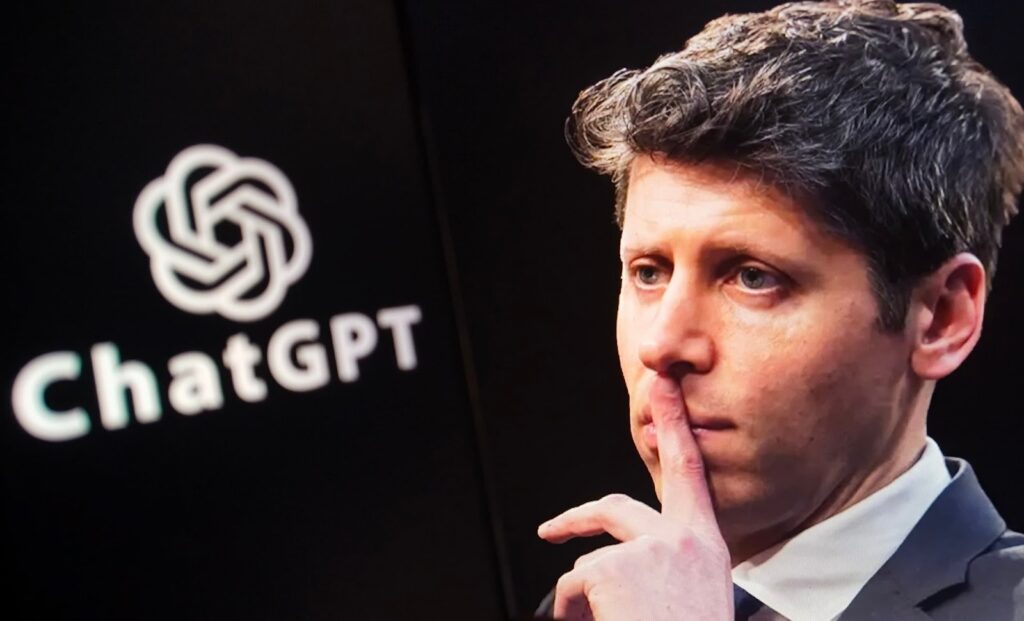
Sam Altman Built ChatGPT. Now He Says He Can’t Raise His Baby Without It — Literally – © Shutterstock
OpenAI CEO Sam Altman has sparked debate after claiming that raising his newborn would be “impossible” without the help of his company’s AI chatbot, ChatGPT.
Sarah Talbi
Published on December 19, 2025
Altman’s comments come at a time when public scrutiny of artificial intelligence is increasing, especially regarding its influence on parenting and personal decision-making. In his words, ChatGPT has become a daily tool in navigating fatherhood, prompting both surprise and concern over the role AI now plays in private family life.
Speaking to Jimmy Fallon on The Tonight Show, Altman described how deeply integrated the AI has become in his experience as a new parent. “I cannot imagine having gone through, figuring out how to raise a newborn without ChatGPT,” he said, adding that he regularly consults the chatbot for advice—ranging from baby behavior to developmental questions.
“Clearly, people did it for a long time—no problem. But I have relied on it so much,” he admitted during the interview, according to Futurism. He even recalled hiding in a bathroom during a social gathering to ask the chatbot whether it was normal that his baby couldn’t walk at six months.
From Parenting Assistant To Primary Caregiver?
According to UNILAD, Altman admitted to using ChatGPT frequently when it comes to raising his newborn son, whom he welcomed in February. While the CEO’s statements seemed designed to be light-hearted, they also underline how embedded AI tools have become in everyday parenting. He reportedly used ChatGPT to understand why his son was “dropping pizza on the floor and laughing,” reflecting how even the most mundane aspects of parenting are now filtered through an AI lens.
The comments triggered a wave of criticism online. Many questioned whether Altman’s experience reflects that of most parents, considering his financial means and presumed access to human support like nannies or medical professionals. As one social media user put it, “Sam Altman almost certainly has a full-time nanny who does not consult ChatGPT.” Others accused the OpenAI CEO of attempting to distract from the company’s current struggles by appearing on a talk show with a relatable story.
Researchers Warn About Advice Accuracy
The use of generative AI tools like ChatGPT in parenting has been under scientific scrutiny. A 2024 study led by University of Kansas doctoral student Calissa Leslie-Miller found that parents often struggle to distinguish real medical advice from content generated by AI. During the study, some outputs from ChatGPT included incorrect information. “This is concerning because, as we know, AI tools like ChatGPT are prone to ‘hallucinations’—errors that occur when the system lacks sufficient context,” Leslie-Miller stated.
According to the same research, the widespread adoption of AI for parenting decisions presents serious risks. The study called for “expert oversight of ChatGPT” to ensure safe handling of child healthcare information. Without validation from qualified professionals, advice from AI models could mislead stressed or inexperienced parents, especially in moments of urgency or uncertainty.
The issue, as researchers point out, isn’t just about inaccuracy but also about how persuasive and authoritative AI-generated content can seem. This makes it even harder for users to judge when the information is wrong, particularly in the absence of medical or developmental expertise.
Growing Dependence And Its Blind Spots
Despite the risks, more parents are turning to AI to navigate the overwhelming landscape of early child care. According to Futurism, Dartmouth College associate professor Nicholas Jacobson explained that “a huge and growing number of parents are using them.” He emphasized that many rely on AI chatbots to support sleep schedules, interpret pediatrician notes, or understand baby behaviors.
Still, experts insist that no chatbot can substitute a real pediatrician or the instincts of a caregiver. “General-purpose models aren’t trained on validated parenting science,” Jacobson said. “Their advice can be generic, wrong, or reflect the biases in their training data.” Adolescent psychologist Sophie Pierce also noted that parents may use AI tools as emotional crutches under high stress, which could amplify the risk of accepting faulty information as fact.
Critics have also tied Altman’s appearance to broader concerns about OpenAI’s future. The company is currently facing steep competition from rivals like Google and increased pressure from investors worried about escalating costs. As Futurism noted, AI commentator Ed Zitron described the situation bluntly: “We’re at the desperation stage… They have no idea what to do anymore.”
Despite the backlash, Altman’s comments spotlight an evolving reality: artificial intelligence is no longer a tool for the future—it’s already shaping the intimate, unpredictable world of parenting. Whether that’s a step forward or a cause for pause remains an open question.
Original:
Sam Altman Built ChatGPT. Now He Says He Can’t Raise His Baby Without It
 admin
admin