Canada is investing approximately $10 billion in a 670 km mega-pipeline to cross mountains and break its energy dependence on the United States: the project carries gas from the interior to the Pacific and redefines the country’s role in the global energy market.
 admin
admin 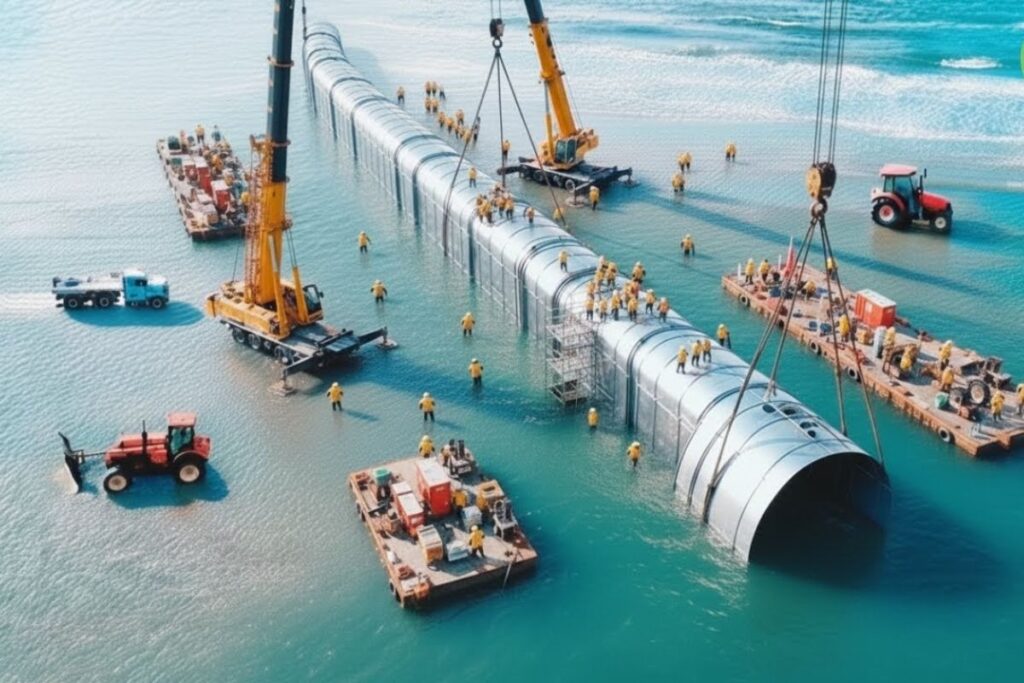
Canada’s mega-pipeline carries natural gas to the Pacific via LNG Canada, reducing energy dependence and redefining the global energy market.
Written by Maria Heloisa Barbosa Borges
Published in 09/01/2026 at 11:31
With an investment of approximately US$10 billion, the Coastal GasLink mega-pipeline runs through forests, rivers, and mountains, creating 25,700 jobs and connecting inland reserves to the liquefaction plant in Kitimat.
Canada is redesigning its energy map with a mega-pipeline of approximately 670 km, designed to cross dense forests, overcome mountain ranges, and provide a direct outlet to the Pacific Ocean. The operation, estimated at around 10 billion dollars, aims for a stated objective:to reduce the United States’ energy dependenceand to reposition the country in the global market.
In practice, the mega-pipeline became a continuous-paced project, with work crews operating 24 hours a day, helicopters in regular operation, crossings of hundreds of waterways, and isolated construction sites in the middle of the forest. At the same time, the project accumulated…Controversies related to conflicts in indigenous territory, environmental impacts, and questions about the actual distribution of profits
The energy dependency that pushed Canada towards the Pacific.
Canada has abundant natural gas reserves, but for decades it has had few avenues to transform this resource into economic advantage. International geological estimates indicate approximately2.4 trillion cubic metersin proven natural gas reserves. The problem is geographical: the largest producing areas are in the interior of Alberta and northeastern British Columbia, separated from the coast by extensive mountain ranges.
Without a direct corridor to the sea, the country long operated with a dominant alternative: selling gas to the United States via pipelines.
In 2024, Canada exported natural gas at a record level, with an average exceeding…250 million cubic meters per dayHowever, volume did not translate into proportional gain.
With advances in domestic extraction, the United States began to have an oversupply, putting pressure on prices and reducing Canadian revenues by almost [amount missing].30%compared to previous years.Canada exported more, but earned less.
It was at this point that the mega-pipeline gained strategic importance: to create a maritime export route to access markets with potentially higher prices, especially in Asia, and to weaken energy dependence on a single buyer.
The 670 km mega-pipeline that “divides” the country’s energy history.
The mega-pipeline was designed to connect the Dawson Creek region in northeastern British Columbia to Kitimat on the Pacific coast. The length cited in the plan itself appears to be approximately669 km, rounded to670 km, on terrain that does not behave like a simple continuous strip.
The project began to be designed back in 2012, when TransCanada, later TC Energy, was selected to design, build, and operate the corridor.
Official construction began in 2019, after years of preparation, licensing, and adjustments. The route required cutting through forests, crossing rivers, and traversing successive mountainous areas.
The mega-pipeline has a diameter of41.22 incheslarge enough for an adult to stand inside, and designed to carry approximately2.1 billion cubic feet of gas per day, or equivalent to about59 million cubic meters per day.
This volume is what underpins the logic of the project:To extract the gas from the interior and push it, on an industrial scale, to the Pacific Ocean.
Why did the cost jump to around 10 billion dollars?
The budget is one of the central points of the story. The cost projection was revised upwards and, around 2023, it went from…6.4 billionfor approximately10 billion dollarsThis leap helps explain why the mega-pipeline became known as one of the most over-budgeted energy projects in recent Canadian history.
A recurring factor in technical descriptions is the combination of geographical difficulty and operational demands. The project wasn’t just about “laying pipes.”
Before installation, teams needed to drill, stabilize slopes, build drainage systems, and reinforce embankments. In many sections, the safe working window is short, and weather changes within the same day can be severe, with temperature variations exceeding [amount missing].20°Cand alternating between sun and snow.
Furthermore, the financing was also structural. TC Energy sold65%The company raised capital for the project and secured loans and guarantees, which reinforces the interpretation that the “energy independence” pursued by the mega-pipeline was built, in large part, on debt and financial partnerships.
Extreme construction in the mountains: the defining challenge of the mega-pipeline.
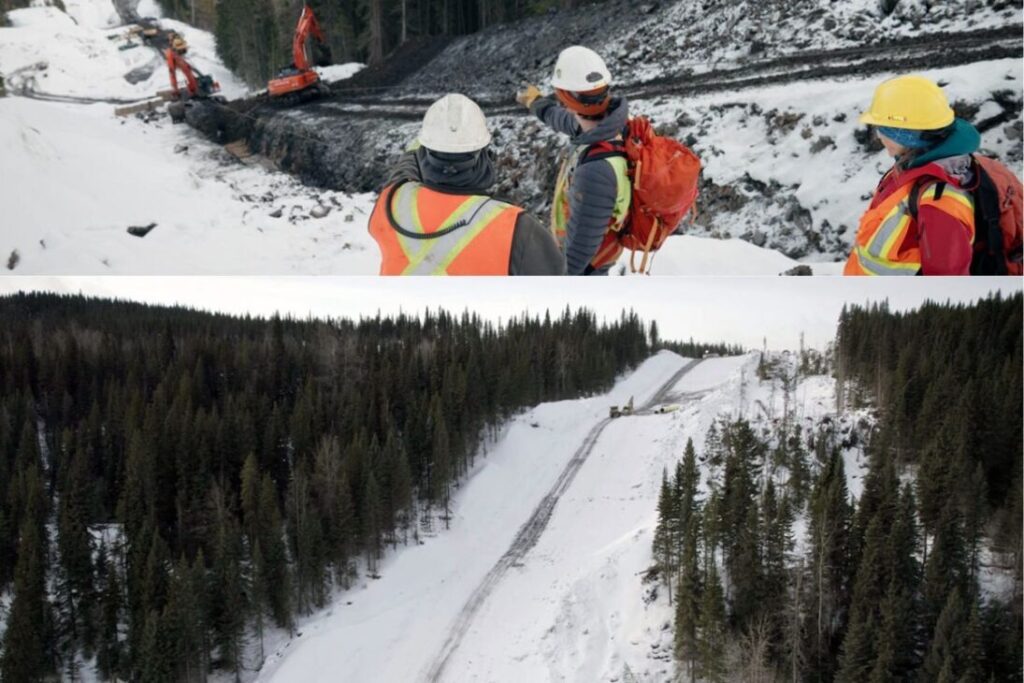
On the map, the mega-pipeline looks like a line. On the ground, it crosses the Western Cordillera, with sections of steep incline above…45 degrees, comparable to climbing a continuously inclined staircase equivalent to the height of a tall building.
There are areas with rocky cliffs, others with soft slopes and muddy plateaus, where heavy machinery can sink and move inch by inch.
After heavy rains, the soil can shift between5 to 15 cm per day, increasing the risk of landslides. With rainfall above40 to 50 mm in a few hoursInstability increases significantly compared to dry conditions.
The mega-pipeline also had to contend with areas where summer worsens the terrain: the thaw softens the soil, making it unable to support weight.
At times, construction sites were closed for weeks awaiting short windows of favorable weather. In inaccessible areas, the work utilized cable cranes, winch systems, and aerial transport, with pipe segments weighing tens of tons suspended in the air.
This combination of risk and precision is repeated by those who describe the execution:A misalignment of even tens of centimeters during a lifting operation can compromise the operation and put the team at risk.It’s the kind of scenario where the mega-pipeline moves forward, but always under the logic that “making a mistake is costly.”
Seven hundred water crossings and logistical operations in isolated territory.
Along the route, the mega-pipeline had to crossmore than 700 streams and riversFrom small streams to larger, cold, fast-flowing rivers, each crossing required a specific solution.
In sections with controllable traffic flow, temporary steel and wood bridges were built to support heavy equipment for a short period.
Where the terrain allowed, teams waited for winter, when rivers freeze and create solid surfaces tens of centimeters thick.
For larger rivers with continuous current, the alternative was to install the pipeline below the riverbed, with drilling, excavation, and installation in near-freezing water conditions, close to0°C.
Access infrastructure also became a chapter of its own. In areas without roads or electricity, teams opened hundreds of kilometers of temporary routes, usable only for a few seasons. When these routes became impassable, helicopters took over the transport of pipes, machinery, and personnel.
This is the context from which one of the most frequently cited metrics emerges:The route alone would have generated more than 25,700 jobs., operating 24 hours a day. This number appears as one of the arguments to defend the immediate economic impact of the mega-pipeline.
The conflict with the Wet’suwet’en and the pressure regarding rights and consent.
The mega-pipeline does not cross an “empty land.” The route passes through approximately22,000 square kilometersfrom unceded Wet’suwet’en territory, where traditional authority is held by hereditary chiefs, and not by elected councils recognized by the Canadian government.
This is where the conflict originates. While some councils have reached economic agreements, traditional leaders have stated that they never granted permission for the mega-pipeline to cross their territory.
Tensions have also grown for environmental reasons: the route crosses more than206 ecologically sensitive waterwaysMany of these areas are spawning grounds for salmon, an element of cultural and economic importance to local communities.
There is also the connection to the origin of the gas. The mega-pipeline was designed to transport gas extracted via hydraulic fracturing, a method criticized for risks to water and public health.
Wet’suwet’en leaders declared that the project violated their traditional legal system and the principle of free, prior and informed consent associated with the United Nations Declaration on the Rights of Indigenous Peoples, adopted by Canada at the federal and provincial levels. A UN committee even called for an immediate halt to construction until genuine consent was obtained.
The response, according to the chronology described, was law enforcement. Between 2019 and 2021, the Royal Canadian Mounted Police spent almost20 million Canadian dollarswith security in the territory.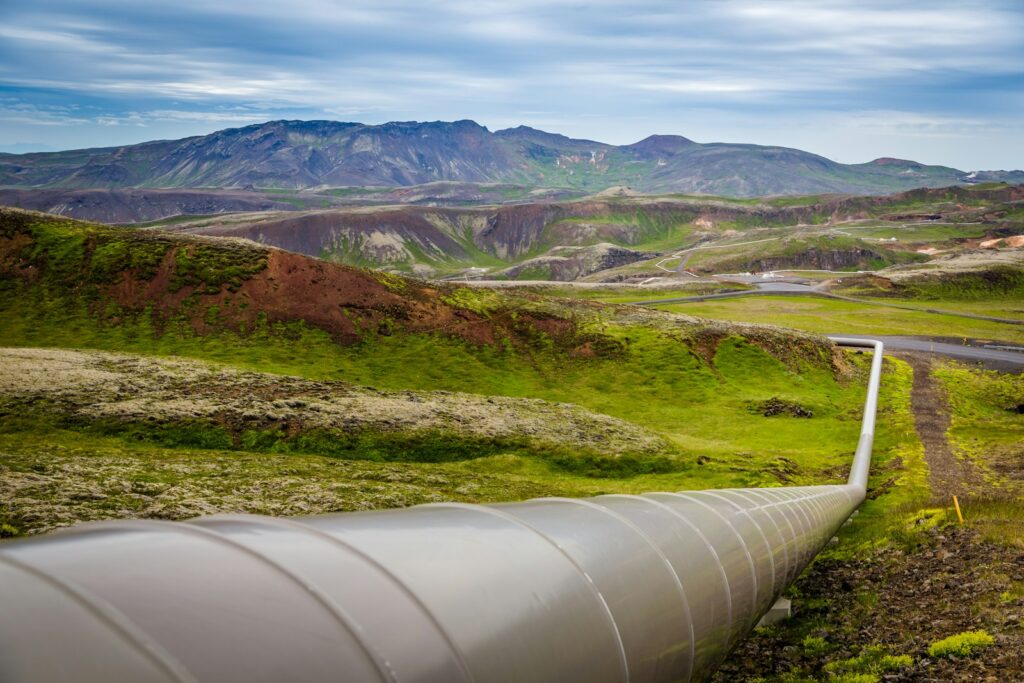
Operations in January 2019 and February 2020 involved armed police, dogs, and helicopters. The local conflict escalated into nationwide protests, with rail blockades and highway disruptions between 2019 and 2022.
In 2021, tensions increased with the approval of a route change that allowed the destruction of a protected archaeological site, about 200 meters from a protest camp.
Despite delays and concessions, the project moved forward. Among the elements cited to unlock progress are compensations and contracts, including$1.8 billionin contracts awarded to local and indigenous businesses.
Why the mega-pipeline only makes sense with liquefaction in Kitimat.
One point is often overlooked outside the industry:Gas inside a pipe is still just gas.To export fuel that crosses oceans, it’s necessary to liquefy it, reduce its volume, and make it transportable by ship. This is where LNG Canada in Kitimat comes in, described as the largest energy construction site in Canadian history.
The liquefaction and export plant on the Pacific coast has an approximate cost of$28.8 billionWhen you add in the mega-pipeline and associated infrastructure, the total cost of transporting gas from the interior to the ocean reaches approximately40 billion dollarsThe complex occupies an area of approximatelyfour square kilometers, with storage tanks, steel modules, port infrastructure and a workforce in continuous operation.
Phase 1 was designed with two liquefaction trains. The gas arrives via the coastal pipeline, undergoes descaling, and is cooled to less than [temperature missing].161°C, changing from a gaseous state to a liquid state. Once liquefied, the volume reduces by approximately600 times, allowing for storage and pumping for LNG ships.
The design capacity of Phase 1 is…14 million metric tons of LNG per year, equivalent to about19 to 20 billion cubic meters annually, or almost1.7 billion cubic meters per monthThe primary target markets described are Asian markets such as Japan, South Korea, and China.
By 2024, the integrated system, mega-pipeline and liquefaction plant, was operational, marking for the Canadian media a turning point in the country’s energy industry.
Risky timing: Canada arrives at the ocean when the ocean is “already crowded”
The mega-pipeline and LNG Canada reached the operational stage in a delicate scenario. In 2024, global natural gas prices fell to their lowest level in almost four years, amid prolonged oversupply.
The United States, which for decades had been Canada’s biggest customer, no longer depended on Canadian gas in the same way, with the shale gas boom and the construction of multiple LNG terminals within a decade.
At the same time, competitors were advancing. Qatar was expanding North Field with low costs and long-term contracts, while Australia already had a consolidated presence in Asia for 10 to 15 years, with a stable customer base.
Canada, therefore, entered the maritime market strongly just when the market began to cool down.
There is also the factor of the climate outlook. LNG projects are planned to operate for30 to 40 years oldMeanwhile, global climate goals point to drastic reductions in the use of fossil fuels before 2050.
If demand for LNG falls faster than expected, structures valued at tens of billions could become physically existing but economically fragile assets.
Whose project is it: a multinational joint venture with outward value streams.
Although the mega-pipeline is described as a Canadian breakthrough, LNG Canada’s corporate structure is multinational. Shell appears with40%and acts as an operator.
Petronas has25%PetroChina15%, e Mitsubishi e Korea Gas Corporation 5%Each. No Canadian company holds controlling interest.
The British Columbia government described the complex as the largest private investment in its history.
But there is a relevant detail regarding the expenses: in Phase 1, only about$2.5 to $4.1 billionwere spent directly within the province, whilebetween 7 and 11.1 billion dollarsProduction of modules, equipment, and core systems flowed outward. Steel modules were manufactured in Asia and shipped by sea to Kitimat.
The critical reading that emerges from this design is straightforward: British Columbia carries environmental and social risks, while a considerable portion of the most economically dense industrial value may be concentrated elsewhere.
The 2025 milestone: first commercial shipment and the Pacific route open
After more than a decade of preparation, controversy, and construction, at the end of June 2025, Kitimat departed.first commercial shipment of LNG, symbolizing the effective opening of the Pacific route for Canadian gas.
The question that reappears in this context is why Canada did not prioritize exporting to Europe via the east coast. The answer described involves geography and politics: the east coast has fewer reserves, and transferring gas from the west to the Atlantic would require thousands of additional kilometers of pipelines, with even greater risks and costs. Furthermore, environmental opposition on the east coast is described as strong and persistent, leading to the cancellation of several projects.
The plan, therefore, is to operate as a steady flow. The first shipments are treated as tests under real-world conditions, with priority given to operational stability, temperature control, pumping, and port coordination.
The cascading effect: Cedar LNG and the discussion about a phase 2.
With the infrastructure already in place, Kitimat will function as a hub that can attract other projects. One example cited is Cedar LNG, a floating installation with an approximate capacity of…3.3 million tons of LNG per yearSmaller than LNG Canada, but promising greater flexibility and a reduced land footprint.
At the same time, the discussion about expanding Phase 2 of LNG Canada has resurfaced, because the original design left technical room to expand capacity if the market allows.
If implemented, the additional phase could nearly double capacity, transforming Kitimat into one of the largest LNG export hubs on the North American Pacific coast. The critical point, again, is long-term demand.
Environmental impacts and chain risks: from fracking to the ocean.
The environmental dimension of the mega-pipeline appears in multiple layers. There is the risk associated with methane: if leaks reach…2% a 3%The climate advantage of LNG over coal may practically disappear, since, in the first 20 years, methane has a warming impact of approximately…84 timesstronger than carbon dioxide.
The route’s path through sensitive river basins and waterways intensifies concerns about sediment, water quality, and salmon populations over the years, with potentially long-lasting effects.
At the source of the gas, hydraulic fracturing uses millions of liters of water mixed with chemicals per well, with the potential to contaminate groundwater and air.
Around Dawson Creek, local doctors have reported an increase in health problems, such as prolonged nosebleeds, respiratory illnesses, heavy metals detected in drinking water, and certain rare cancers. The causal relationships remain debated, but the overlap in time and space is described as sufficient to keep communities uneasy.
The risk of accidents is also evident in recorded spills. In 2020, there were two diesel spills in the Wet’suwet’en area.
In August 2021, an additional spill of approximately [amount missing] was reported.1,000 litersat a construction camp.
There are also reports of erosion control violations, inadequate waste management, and delays in implementing ecological protection plans.
What does the mega-pipeline really change for Canada?
The mega-pipeline and LNG Canada consolidate a structural change: Canada is no longer just a seller of gas via pipeline, but has become a maritime exporter of LNG, with direct access to the Pacific.
This reduces the United States’ absolute energy dependence.and creates the possibility of pricing that is more aligned with global markets.
But this turnaround comes with costs and risks that are also structural: debt and budget overruns, prolonged social conflicts, environmental impacts, and the uncertainty of an energy market that could radically transform in the coming decades.
Added to this is the multinational nature of the value chain, which raises the question of where the biggest industrial gains are concentrated.
Ultimately, the mega-pipeline is not just a corridor of pipes. It functions as a strategic divider:Canada chooses to cross mountains, connect the interior and the ocean, enter the LNG game, and accept the tensions and risks that come with that decision.
Original:
https://clickpetroleoegas.com.br/o-canada-investe-cerca-de-10-bilhoes-de-dolares-em-megagasoduto-de-670-km-para-cruzar-montanhas-e-romper-a-dependencia-energetica-dos-estados-unidos-mhbb01