The Pantheon: if the Roman Empire erected the largest unreinforced concrete dome and it withstood two thousand years, why do modern structures crack in decades?
 admin
admin 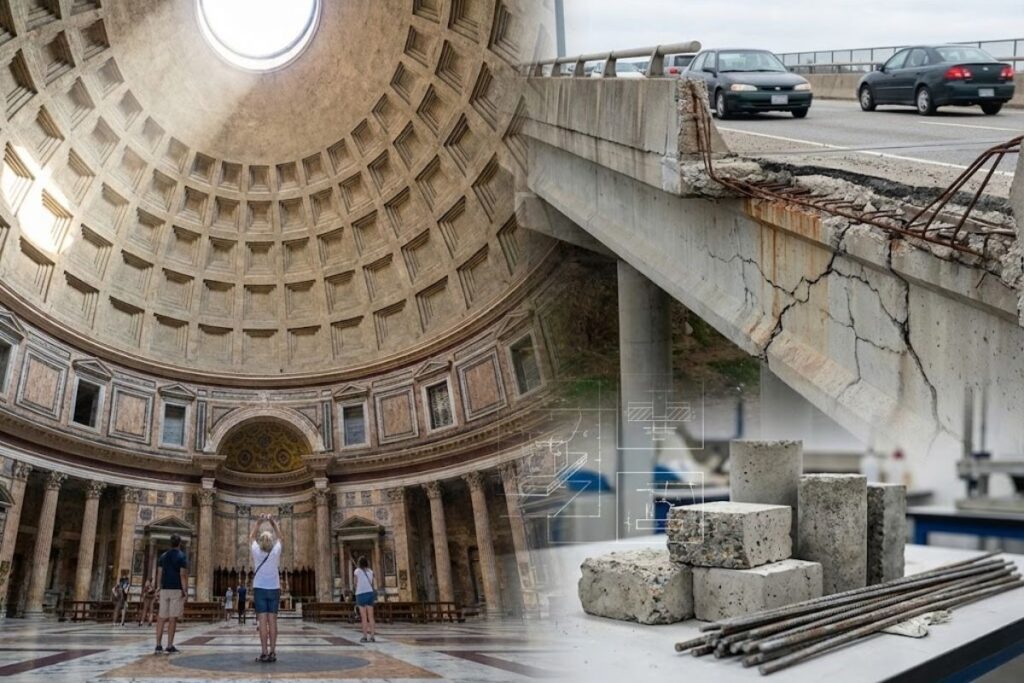
The largest unreinforced concrete dome in the Pantheon raises debate about durability; steel and water influence resistance; volcanic ash plays a role in the chemistry; economics defines lifespan and maintenance.
Written byBruno Teles
Published in07/01/2026 at 14:07
Built almost two thousand years ago, the largest unreinforced concrete dome of the Pantheon survives without steel reinforcement, while current bridges and viaducts crack due to corrosion. Between water in the mix, volcanic ash, and economic decisions, durability becomes a technical debate about compression, tension, and maintenance even here today.
The Pantheon houses the largest unreinforced concrete dome in the world, built almost two thousand years ago, and this enduring quality necessitates a direct comparison with modern structures that crack within a few decades. When the largest unreinforced concrete dome remains intact, the question ceases to be a historical curiosity and becomes a diagnosis of how…steel, water, volcanic ashDesign choices shape durability.
The discussion isn’t simply about saying the Roman Empire “got it right” and modern engineering “goes wrong.” It involves structural mechanics, mixing chemistry, and construction economy.What a structure needs to support, for how long, and at what cost.It is at this intersection that the Pantheon becomes a technical reference point, and the largest dome ofunreinforced concreteThis becomes an awkward comparison for contemporary infrastructure.
The Pantheon and the question that won’t leave the construction site.

The largest unreinforced concrete dome is in the Pantheon, an ancient Roman temple built almost two thousand years ago.
The contrast is stark because modern concrete designs, even those with a solid appearance, can exhibit cracks, fragmentation, and loss of maintainability after just a few decades.
The question that emerges from the Pantheon is straightforward: if a structure from the Roman Empire can endure for centuries, why do so many modern structures require repairs sooner, or exhibit visible damage within a short period?
The response, in the material presented, does not point to a single culprit.
It combines the role of steel, the role of water in the mixture, the effect of volcanic ash, and the impact of economic decisions on service life.
Steel: a solution for tensile strength, a frequent source of cracks.

Reinforced concrete with steel bars is described as the foundation of modern society.
Reinforcement is necessary because concrete is strong in compression but weak when subjected to tensile stress.
In slender structures, in parts with large spans, and in elements that need to withstand bending, tension appears as an unavoidable condition. To resist it, steel is used.
Steel is included for practical reasons listed in the report: robustness, thermal behavior similar to concrete, availability, and low cost.
But steel has a defining weakness: it rusts.
Corrosion of embedded steel reduces the strength of the reinforcement and, by producing iron oxide, generates expansion.
This expansion creates internal stresses in the concrete and leads to cracking, fragmentation, and eventually, complete loss of serviceability, i.e., failure.
The key point is that corrosion of embedded steel reinforcement is presented as the most common form of concrete deterioration.
This helps explain why modern engineering, despite being more sophisticated in methods and calculations, can suffer from a recurring mechanism.
Steel makes reinforced concrete viable, but it also introduces a typical damage pathway.
Without steel and with geometry: how the Romans maintained compression.
The Romans circumvented the problem in a simple way: they didn’t put steel in the concrete.
To support structures without reinforcement, the strategy was to use geometry to ensure that the concrete primarily resisted compression and almost never tension.
The arch and the dome appear as the main features of this reasoning.
The summit distributes efforts in a way that prioritizes compression.
Following this logic, the largest unreinforced concrete dome in the Pantheon ceases to seem like a miracle and begins to appear as a sound structural decision: to reduce tensile stress and therefore reduce the need for steel.
By eliminating the steel, you also eliminate the most vulnerable point cited for the durability of reinforced concrete: corrosion of the reinforcement.
Another resource mentioned is mass.
The simplest way to keep concrete under compression is to put weight on top of it, literally more concrete.
The report uses this reasoning to show that the modern era also applies the same principle to large concrete dams.
Gravity dams and arch dams are designed to withstand water pressure based on their own weight and geometry, reducing tensile stress and decreasing the need for steel.
That is why the cross-section of these structures grows with depth.
Here, the word water appears with a dual role.
Water is the external load that exerts pressure on a dam. And water is also an ingredient in concrete that defines its strength and durability.
The question of the Pantheon transcends these two dimensions.

Water in the mixture: water-cement ratio as a turning point.
One factor described as fundamental and decisive is the water-to-cement ratio.
The cited demonstration shows that the strength of concrete decreases as more water is added.
The extra water dilutes the cement paste and weakens the concrete as it cures.
According to the material presented, the Romans already valued this relationship.
Historical manuscripts indicate that Roman architects sought to mix the material with as little water as possible and then tamp it into place using special tamping tools.
Instead of “gaining workability” with more water, the method was to reduce water and compensate with processing and compaction.
This detail helps explain why the largest unreinforced concrete dome can last so long. Durability doesn’t depend solely on the absence of steel.
It also depends on how water was used in the mixture and how the concrete was placed and compacted.
Volcanic ash and durable minerals: the 2017 observation.
Another frequently cited hypothesis for the durability of Roman concrete is chemistry.
The material presented mentions that, in 2017, scientists discovered that the combination of seawater and volcanic ash used in ancient structures can create extremely durable minerals, not normally found in modern concrete.
This passage positions volcanic ash as a central component of the debate, not as an exotic detail.
The presence of volcanic ash appears to be associated with a durable result.
At the same time, the material itself highlights that the present is not bound to a “lost recipe”: the science of optimized mixtures has advanced to a level that a Roman engineer could not have imagined.
The conflict, then, is not between the past and the present.
It’s a matter of technical capability versus practical decision-making. If there are tools to produce resilient concrete, the question shifts to design, control, and cost.

CCR: low water content, compaction, and the technical bridge using the Roman method.
There is a modern process described as similar to the Roman method of low water and compaction: Roller-Compacted Concrete, or RCC.
It uses ingredients similar to conventional concrete, but with much less water, creating a dry mix.
Instead of flowing like a liquid, RCC is moved with earthmoving equipment and compacted in place with vibratory rollers.
The report indicates that CCR mixtures often include ash, which creates a link to the theme of volcanic ash and the tradition of ash in Roman concrete.
RCC is cited as a common material in large gravity and arch dams because it combines high strength and low cost.
Once again, these are structures that can do without large volumes of steel because they rely on weight and geometry to work under compression.
This point reintroduces the Pantheon into contemporary debate without romanticizing it.
Modern engineering has not “forgotten” the principle of low water usage. It applies it in specific contexts, such as dams, where geometry and mass allow for reduced draft.
Additives and superplasticizers: less water without compromising application.
Not everything can be designed to avoid tension. Modern structures, such as viaducts and skyscrapers, are described as unfeasible without reinforced concrete.
And when there is steel and complex formwork, the concrete tends to be wetter because this facilitates application: it flows in pumps, fills molds, and surrounds the steel.
The modern solution described is chemical. Water-reducing additives, called superplasticizers, decrease the viscosity of the mixture and allow the concrete to remain workable with a lower water content.
The practical effect is to maintain workability without diluting the cement paste, promoting stronger curing.
The cited demonstration compares three batches.
In the first test, with the recommended amount of water, the concrete flows well in the mold and, after a week of curing, breaks at around 2000 psi, approximately 14 MPa, with the caveat that these figures require caution as they are not from a formal laboratory test.
In the second case, with much less water, the mixture does not flow and requires compaction, but it breaks at around 3000 psi, approximately 21 MPa.
In the third batch, the same small amount of water from the second batch is used, and superplasticizer is added, causing the mixture to flow again and maintaining a strength similar to that of the batch with less water.
The material adds an operational detail: in many cases, a workable mixture can be obtained with 25% less water by using chemical additives.
This puts water and durability back at the center of the Pantheon debate, now with modern tools.
Economy and lifespan: why modern concrete doesn’t always aim for millennia.
If chemistry has advanced and additives exist, why might modern infrastructure seem less durable?
The material indicates that the answer is complicated, but points to the economy as a relevant factor.
The quote that comes to mind sums up the tension: anyone can design a bridge that won’t collapse, but it takes an engineer to build one that almost never collapses.
The idea behind this is the pursuit of efficiency.
The structural engineer’s job is to remove all the extra parts from a structure that are not necessary to meet the project requirements.
And lifespan is just one criterion among many. Much of the infrastructure is paid for by taxes, and building to Roman standards on a modern scale is described as impractical or beyond what the public would consider reasonable.
The Pantheon, in this respect, functions as a mirror.
The largest unreinforced concrete dome reveals that durability can be the result of material choices, water in the mix, volcanic ash, and geometry, but also of economic choices.
The comparison reveals that “lasting” has a price and a priority, and it doesn’t always win in the battle for initial cost.
The Pantheon does not prove that the past was superior.
It demonstrates, with the largest unreinforced concrete dome, a set of factors that reduce deterioration pathways cited for modern concrete: absence of steel and therefore absence of the risk of reinforcement corrosion; geometry and mass to maintain compression; water control in the mix; and the role of volcanic ash in the chemical discussion.
For those who design, execute, or supervise construction projects, the practical conclusion is less philosophical and more objective:Wherever there is steel, the risk of corrosion needs to be treated as a central mechanism for durability; where there is excess water, resistance decreases.wherever possible,The mix design and execution control define what the concrete will be like decades from now..
Original:
https://clickpetroleoegas.com.br/o-panteao-expoe-a-pergunta-incomoda-se-o-imperio-romano-ergueu-a-maior-cupula-de-concreto-nao-armado-e-ela-resistiu-dois-mil-anos-btl96