admin
admin 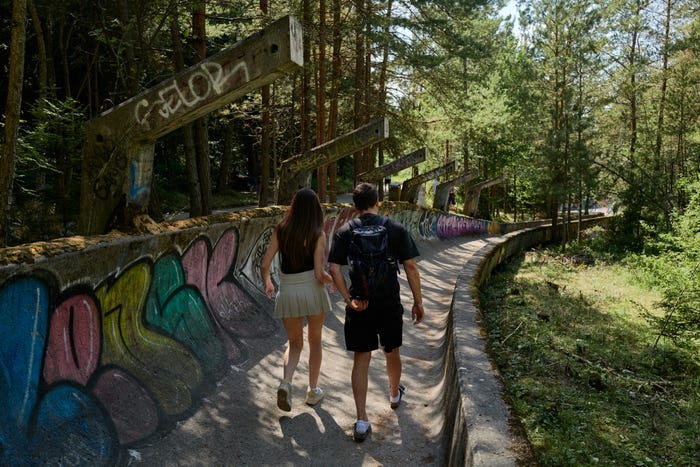
You can explore the remains of the Olympic venues in Sarajevo. Pierre Crom/Getty
By Gabbi Shaw
- The 2026 Winter Olympics are about to kick off in Milan.
- Sometimes cities successfully repurpose parts of their Olympic set-ups, like in Montreal.
- But oftentimes, these giant investments are torn down or abandoned, as these photos show.
It can be an expensive — and potentially damaging — undertaking for a country to host the Olympics.
This year’s games in Italy are costing just $1.6 billion, Reuters reported. While that’s nothing to scoff at, it’s a mere fraction of the $55 billion Brazil reportedly spent in 2016.
A significant part of the expense is building new facilities for the events and housing for the athletes. Then, after the closing ceremonies, some stadiums are used again — there’s always going to be a market for a soccer stadium — but other venues like Olympic pools, kayaking facilities, ski jumping, and beach volleyball can fall into disrepair almost immediately.
These Olympic venues from Berlin, Sarajevo, Athens, Sochi, Rio de Janeiro, and Beijing have all seen better days — take a look at what they looked like once the crowds left.
James Grebey contributed to an earlier version of this story.
In Berlin, there are still remnants of the 1936 Games, 90 years later.
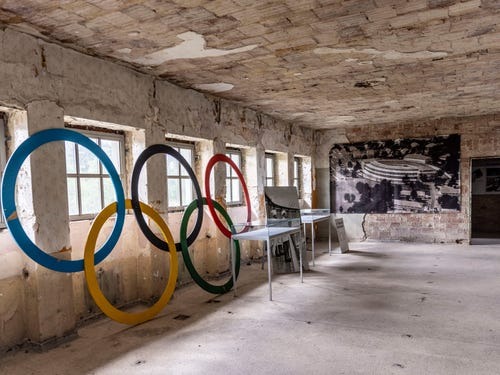
A set of Olympic rings in an abandoned former swimming hall at the site of the 1936 Berlin Olympic Village. Maja Hitij/Getty Images
This building, pictured in May 2021, was once a swimming hall.
Some of Berlin’s Olympic Village still stands, almost untouched.
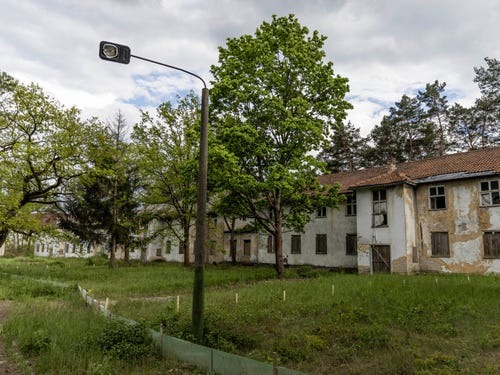
The original abandoned houses for athletes marked with their housing complex names stand at the site of the 1936 Berlin Olympic Village. Maja Hitij/Getty Images
Reports since 2015 have indicated that German developers are renovating some structures — and building new ones — to create residences at a section of the Olympic Village in Berlin.
The 1984 Winter Olympics in Sarajevo, Yugoslavia, took place less than a decade before the Bosnian War.
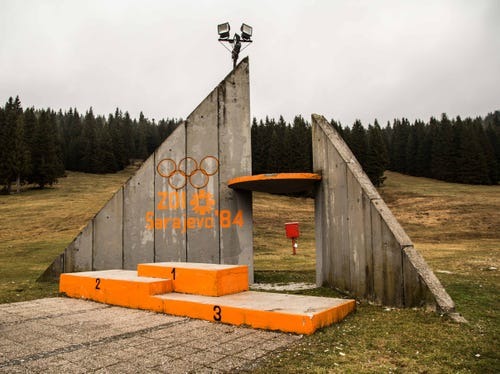
The medal podium at the ski-jump venue. Ioanna Sakellaraki / Barcroft Im / Barcroft Media via Getty Images
Yugoslavia has now been split into Bosnia and Herzegovina, Croatia, Kosovo, Montenegro, North Macedonia, Serbia, and Slovenia. Sarajevo is in Bosnia and Herzegovina.
The city was under siege, and though it’s largely recovered in the years since, many Olympic sites, like this ski jump, have been left to the elements.
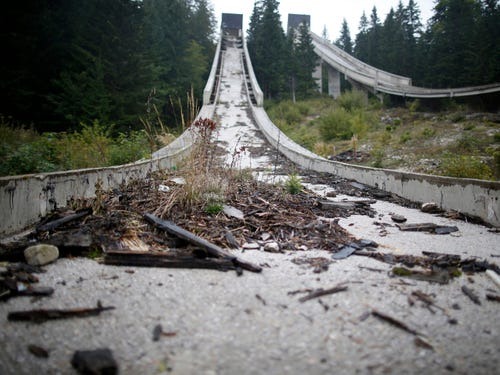
The ski jump. Dado Ruvic/Reuters
In 2024, when Sarajevo marked the 40th anniversary of the Olympics, some of the slopes remained abandoned.
The bobsled course on Mount Trebević is overgrown and covered in graffiti.
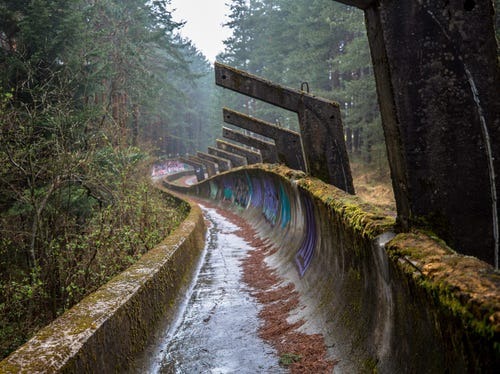
The broken-down bobsled track at Mount Trebević. Ioanna Sakellaraki / Barcroft Im / Barcroft Media via Getty Images
However, the city repaired the cable car, which ferried people to the bobsled events on the mountain, and it reopened in 2018, making it a tourist destination once again.
“In the past few years … the mountain has slowly returned to something like its former self,” The Guardian wrote in 2018. “Hotels, restaurants and cafes have been rebuilt, mines swept away and hikers from all over Sarajevo visit en masse.”
Occasionally, it gets used by brave BMX bikers.
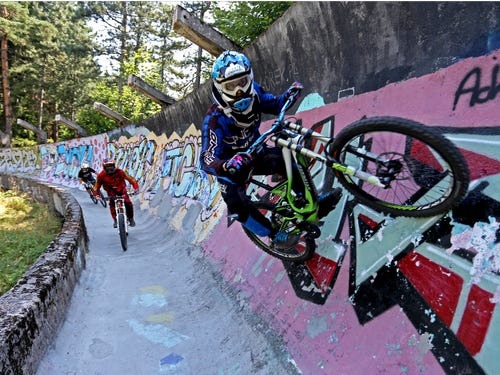
Bikers have used the abandoned tracks to practice. Dado Ruvic/Reuters
Despite some rejuvenation to parts of the area, the bobsled track remains abandoned and covered in graffiti, and moss grows along its walls.
Athens went billions over its planned budget of $1.6 billion for the 2004 Summer Olympics.
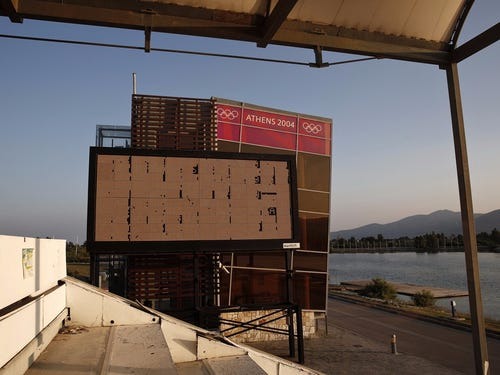
An empty scoreboard at an Athens former Olympic venue. Yorgos Karahalis/Reuters
The Greek government had to pay for everything, and, sadly, there just wasn’t any use for most of the buildings, stadiums, and courses after the Olympics, Time reported eight years later.
A decade later, photos showed a crumbling pool full of fetid water.
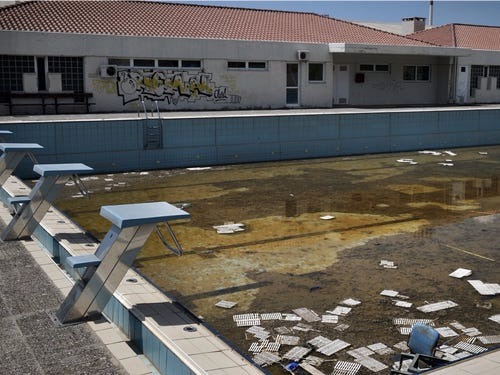
The pool has been filled with standing water for years. Yorgos Karahalis/Reuters
The pool, pictured in 2014, was crumbling.
These huge, abandoned investments must have been especially painful in light of Greece’s financial crisis.
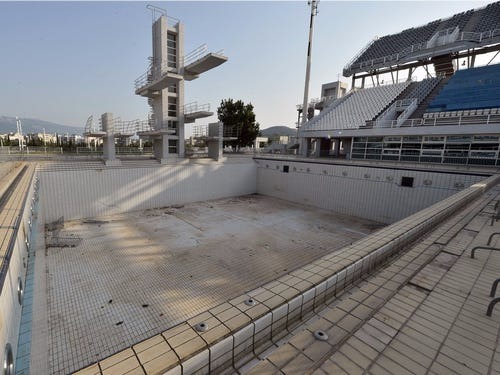
A practice pool at the Aquatic Center in Athens was drained. Yorgos Karahalis/Reuters
The financial crisis led to bailouts for the country starting in 2010.
Understandably, its money wasn’t going toward renovating abandoned buildings.
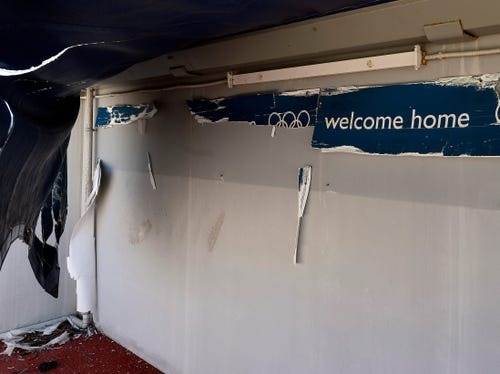
A view of derelict buildings at the Helliniko Olympic complex shows the damage. Milos Bicanski/Getty Images
“Welcome home” says the sign, a reference to Greece being the original site of the Olympics.
A decade after the crowds left, nobody was playing baseball or softball at the stadium in Athens.
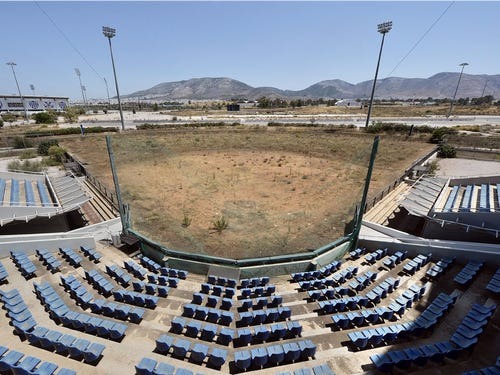
The softball stadium in Athens. Reuters/Yorgos Karahalis
A worker told the London Evening Standard in 2012 that it’s not technically abandoned, it’s just that nobody ever plays softball.
The baseball stadium was used to house refugees in 2016, CNN reported.
It was finally demolished in 2023.
The beach volleyball court in Athens was consumed by weeds.
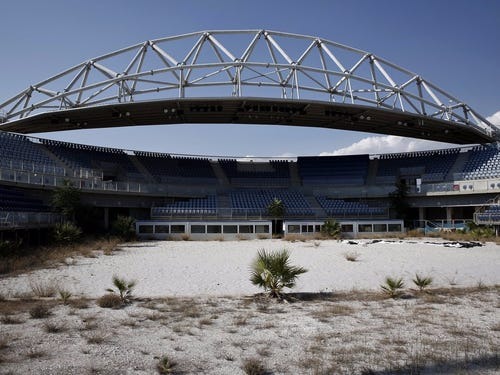
The beach volleyball center, where weeds have grown through the sand. Reuters/Yorgos Karahalis
The stadium was completely empty — apart from the weeds — when it was photographed in 2014.
The Beijing National Stadium, built for the 2008 Summer Olympics, has struggled to find events to fill its 80,000 seats.
The stadium in Beijing. REUTERS/David Gray
It was used again at the 2022 Olympics and became the first stadium to host the Summer, Winter, and Paralympic opening ceremonies.
The rowing facility is largely ignored.
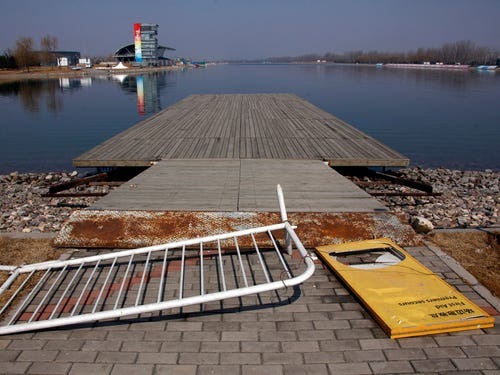
There are barricades on the ground and rusted ramps. REUTERS/David Gray
As the 2022 Olympics were in the winter, much of the specially built summer equipment wasn’t used.
Half of the Beijing National Aquatics Center was eventually remodeled and turned into a water park.
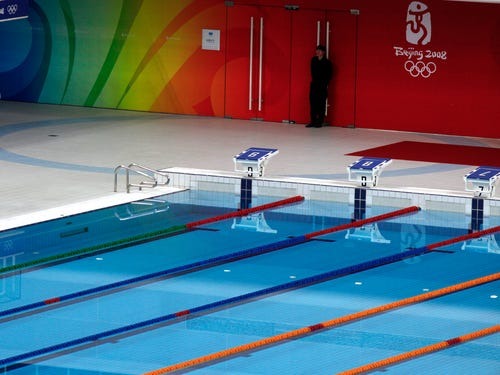
The pool at the Beijing National Aquatics Center. REUTERS/David Gray
It reopened in 2010.
Here’s an abandoned Beibei, one of the Olympic mascots of Beijing, pictured in 2018.
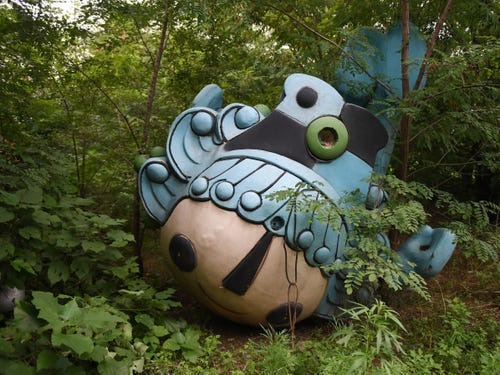
Beibe was one of five mascots for the 2008 Beijing Olympic Games. GREG BAKER/AFP via Getty Images
This is what Beibei should look like.
The 2014 Winter Olympics were held in Russia’s largest resort city, Sochi.
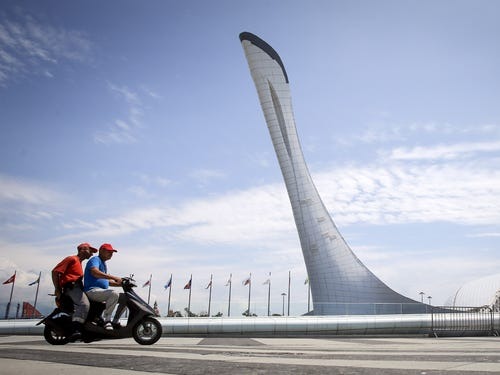
A view of Sochi. Maxim Shemetov/Reuters
It was the most expensive Olympics in history, costing the Russian government $55 billion, according to AP.
The Fisht Stadium was originally a dome, but it was converted to an open-air stadium for the 2018 FIFA World Cup.
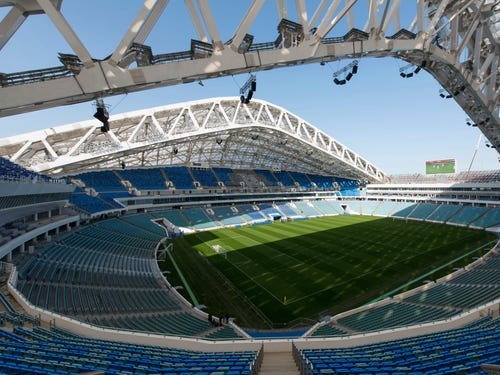
Fisht Stadium started off as a dome, but now has no ceiling. Artur Lebedev/AP Images
Sochi was just one of many cities to host games during the World Cup.
But many other structures have seen limited use, like these ski jumps in Estosadok.
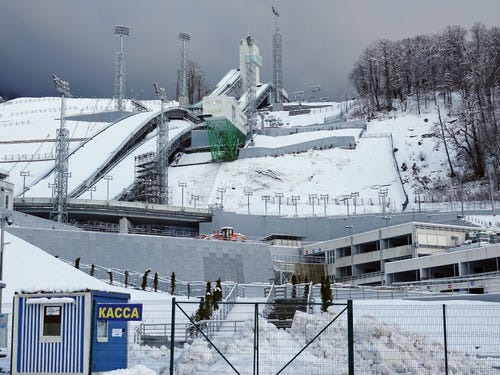
A view of the ski jumps from the 2014 Winter Olympics in Sochi, Russia. Friedemann Kohler/picture alliance via Getty Images
By 2018, when this photo was taken, the facilities had hardly been used.
The Summer Olympics were held in Rio de Janeiro in 2016. In the years that followed, venues like this aquatic stadium became ghost towns.
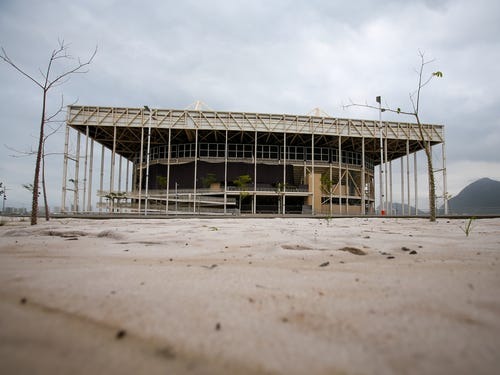
The aquatics center in Rio has seen better days. Buda Mendes/Getty Images
Hopefully, this year’s facilities in Milan and Cortina will have better luck.
Maracanã Stadium was renovated for the Olympics, but it has largely been abandoned.
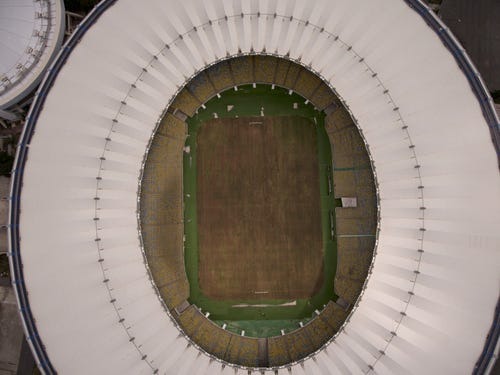
This is Maracanã Stadium from above. Mario Lobao/AP
The Copa América finals in 2021 were held there, though almost no spectators were allowed due to the COVID-19 pandemic.
Vandals stole seats and TVs from the stadium.
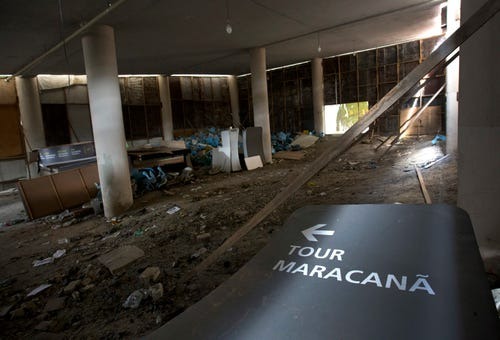
Anything that wasn’t nailed down — and some things that were — were up for grabs. AP/Mario Lobao
Some of it has since been restored.
Original:https://www.businessinsider.com/abandoned-olympic-venues-current-day-pictures-2016-5