admin
admin 
Peter Muller/Getty Images
Plus, what she suggests doing instead for a dreamier sleep.
Dec 4, 2025 4:25 PM EST
By Beth Ann Mayer
Key Points
- Doing one thing before bed disrupts sleep and increases insomnia risk, warns Dr. Hafeez.
- The 3-2-1 rule: stop eating 3 hours, working 2 hours, screens 1 hour before bed.
- Tips: set cutoff times, move phone away, replace this one thing with relaxing activities.
Once upon a time, you may have gone to bed to the sweet sounds of a caregiver reading you a bedtime story and singing you a lullaby. As an adult, you may long for those dreamy routines, especially if you’ve developed some bedtime habits that can make falling and staying asleep a nightmare.
To be fair, there are several other options for how to spend your final waking hours these days. Yet your brain’s nightly need for relaxation and low (or no) stress is as old as time itself.
“The brain works those evening hours to change modes, calm emotions and ready memory systems for tomorrow morning,” explains Dr. Sanam Hafeez, Psy. D., a New York-based neuropsychologist and director of Comprehend the Mind. “If someone is staying up late scrolling or working or worrying, that transition gets disrupted.”
As a result, Dr. Hafeez warns that you might feel foggy, irritable and unmotivated even if you log a solid eight hours of sleep. That’s why, as a neuropsychologist, she never, ever does this one thing before bed. Perhaps ironically (you’ll see), we’ll need you to scroll on to learn what that one thing is, plus what she does instead.
What a Neuropsychologist Never Does Before Bed (and Why)
Dr. Hafeez is an expert in cognitive function, and she knows to never, ever scroll before bed. Research supports her habit of putting her phone to bed before she heads to sleep. One 2025 study indicated that an hour of screen use after climbing into bed can increase insomnia by 59%.
“Scrolling before bed can raise the odds of insomnia by a wide margin because it interferes with almost every step of the body’s natural sleep process,” she shares.
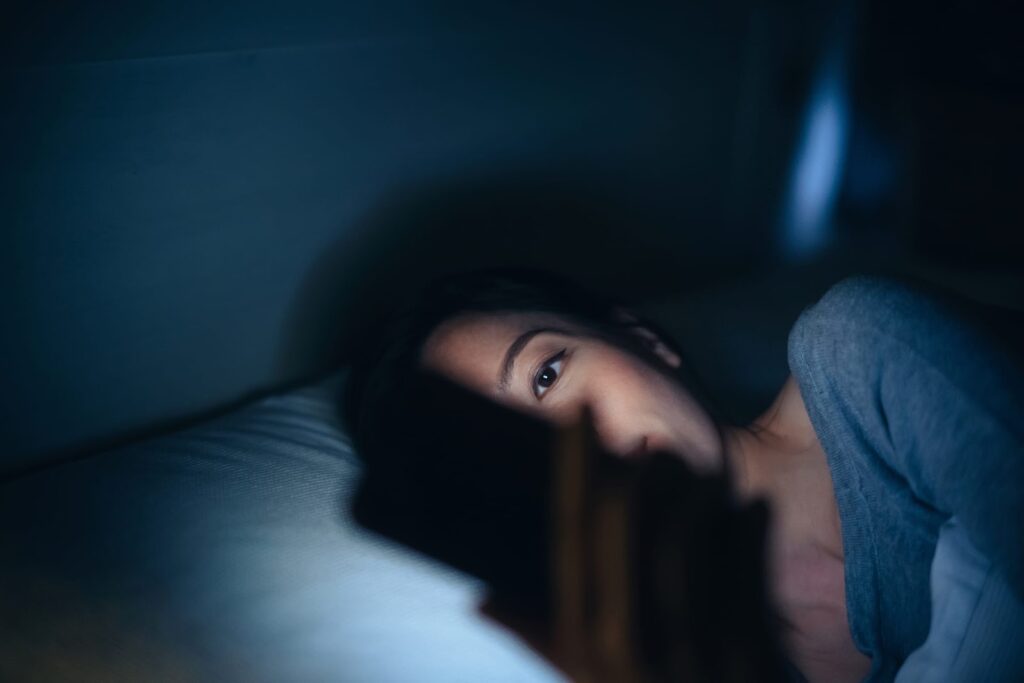
Dr. Hafeez notes that blue light is the biggest culprit. You may have heard the term blue light, but what does it actually mean, and why is it so harmful to sleep? “Blue light matters because the brain is very sensitive to light cues. When evening light fades, melatonin rises. When bright, cool-toned light hits the eyes, the brain holds back that hormone.”
Cue the tossing and turning, trouble heading to dreamland, and waking up groggy after spending a solid seven to nine hours in bed (the CDC’s recommendation for most adults).
“Over time, it chips away at mood, focus and stress tolerance,” Dr. Hafeez shares.
Yet, blue light isn’t the only aspect of pre-bed scrolling that can affect your sleep.
“Stimulation is the other issue,” she points out. “What you read at night can set off emotional and mental reactions that carry straight into sleep. News alerts, messages, dramatic posts or anything stressful keep the brain in a more activated state.”
Unfortunately, closing your eyes isn’t the same as flipping a light switch for your brain.
“That activation doesn’t disappear the moment you close your eyes,” Dr. Hafeez adds. “Even if you pass out from sheer exhaustion, the mind may keep running in the background, which cuts into the deeper, more restorative stages of sleep.”
As a result, you may “wake up on the wrong side of the bed.”
“People often wake up feeling tense, wired or mentally scattered without realizing their bedtime scrolling played a role,” she explains, noting that to feel more refreshed each morning, she avoids scrolling before bed and recommends others do the same.
Related: How Bad Is It Really to Sleep With Your Phone Next to Your Bed?
What Is the 3-2-1 Rule for Bedtime?
“The 3-2-1 rule helps give the brain a predictable path toward sleep,” Dr. Hafeez explains.
Here’s how the countdown-centric wind-down bedtime routine works.
- Three hours before bed. Close the kitchen, or at least stop eating heavy meals. Otherwise, your body will stay busy digesting your food, and it might prevent you from truly resting.
- Two hours before bed. Close business. “Finish up work and decision-making tasks so your mind can let go of the day,” Dr. Hafeez says.
- One hour before bed. Are you ready for it? “Step away from screens so your brain can shift into a slower rhythm without blue light or stimulation pulling it back to alert mode,” she notes.
How To Stop Scrolling Before Bed
Nixing bedtime scrolling habits isn’t as easy as 3-2-1 or 1-2-3. Dr. Hafeez shares three tips that’ll put you in the best position to stop scrolling before bed.
1. Set a cutoff time and be consistent
You’ll need a “blue light’s out” time—AKA when you put your phone to bed. “Routine is usually an effective approach with nighttime technology use,” Dr. Hafeez explains. “Pick a cutoff time, commit to it and pair it with a simple cue like turning down the lights. Your brain will eventually learn that this means the day is over. It will develop into an automatic cue, making it much easier to sleep.”
2. Move your phone out of arm’s reach
Dr. Hafeez points out that one reason your brain (and arms) reach for your phone is that it’s so easy. “If it’s sitting right next to you on the bed, you pick it up out of habit.”
Create some friction. “Put it across the room instead,” she advises. “This increases the distance you have to cover to disrupt the automatic motion. Once your hand isn’t already on the phone, the craving to check it will likely subside on its own.”
3. Replace the compulsion with a relaxing activity
There’s a popular saying, “You’re a human being. Not a human doing.” That’s true, and the point is well-taken. However, Dr. Hafeez doesn’t suggest replacing bedtime scrolling habits with staring at the ceiling.
“Don’t just try to ‘do nothing instead,” she says. “The brain doesn’t work that way. It has to have an alternative habit. Light reading, relaxing stretches, a short and calming audio program or a familiar skincare ritual are all good.”
Social media is also full of luxurious wind-down routines, like bath crystals and ice-rolling your face. However, you don’t have to mimic them, especially if the thought of all of those steps makes you lose sleep (not the point, right?).
“It doesn’t have to take long,” Dr. Hafeez explains. “A soothing activity gives the mind something to focus on as it calms down. These motions will gradually quiet the nervous system, so you’ll find sleep feels more natural.”
Original:
https://parade.com/health/what-to-never-do-before-bed-according-to-neuropsychologist