admin
admin 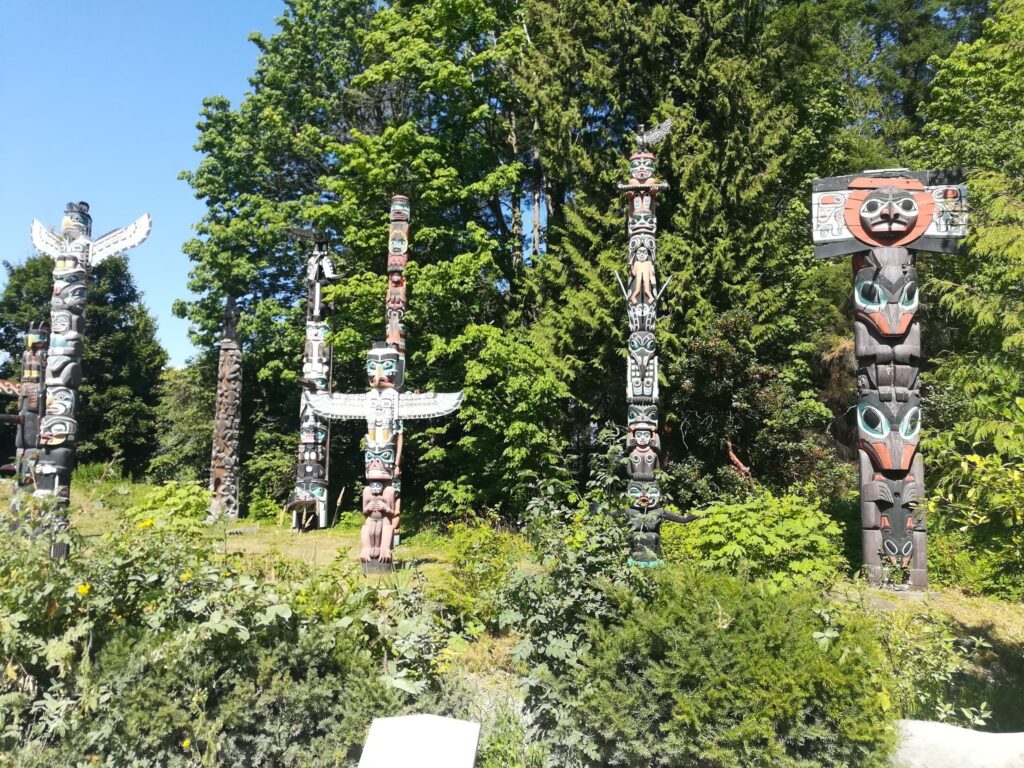
By NatMed, May 26, 2026
Prologue: The Disguised Green Field
Do you think this is just a beautiful city park?
On the edge of downtown Vancouver, Canada, lies a 405-hectare primeval forest, 10% larger than New York’s Central Park. This is the famous Stanley Park. To tourists, it is a perfect cycling paradise and a golden landmark of the Pacific Coast; but behind the dazzling sunshine and verdant shade, deep within this ancient forest lie centuries of countless bones, inexplicable natural phenomena, and dark taboos passed down through the ages by the Indigenous people.
Today, we will completely tear away the disguise of Vancouver’s most beautiful image and take you into the darkest and most thrilling secrets of this green heartland.
Stanley Park is not only a symbol of Vancouver, but also a controversial place filled with power, bloodshed, capital, and forced evictions. From an ancient sacred site for Indigenous peoples to a military fortress of the British Empire, and now a world-renowned tourist destination, its historical timeline is filled with the greed of those in power and unsolved mysteries.
Let’s turn back the clock. Thousands of years BC, this land was home to the Sukwamesh and other indigenous tribes. In 1792, British explorer Captain George Vancouver arrived, officially beginning colonial expansion. In 1863, to defend against a potential American invasion, it was designated a military reservation. This defensive political decision, ironically, saved this primeval forest from the catastrophic destruction caused by early industrial deforestation.
On September 27, 1888, the park officially opened to the public and was named after Lord Stanley, the then Governor General of Canada. On the opening day, David Oppenheimer, Vancouver’s second mayor, presided over a grand ceremony from the podium. But what this shrewd mayor and the colonial government behind him did not tell you was that behind this lavish opening ceremony lay decades of extremely cruel forced evictions and destruction of homes for the Indigenous people who had lived there for generations.
Chapter 1: The Wailing Wall and Armed Standoff on Dead Man’s Island
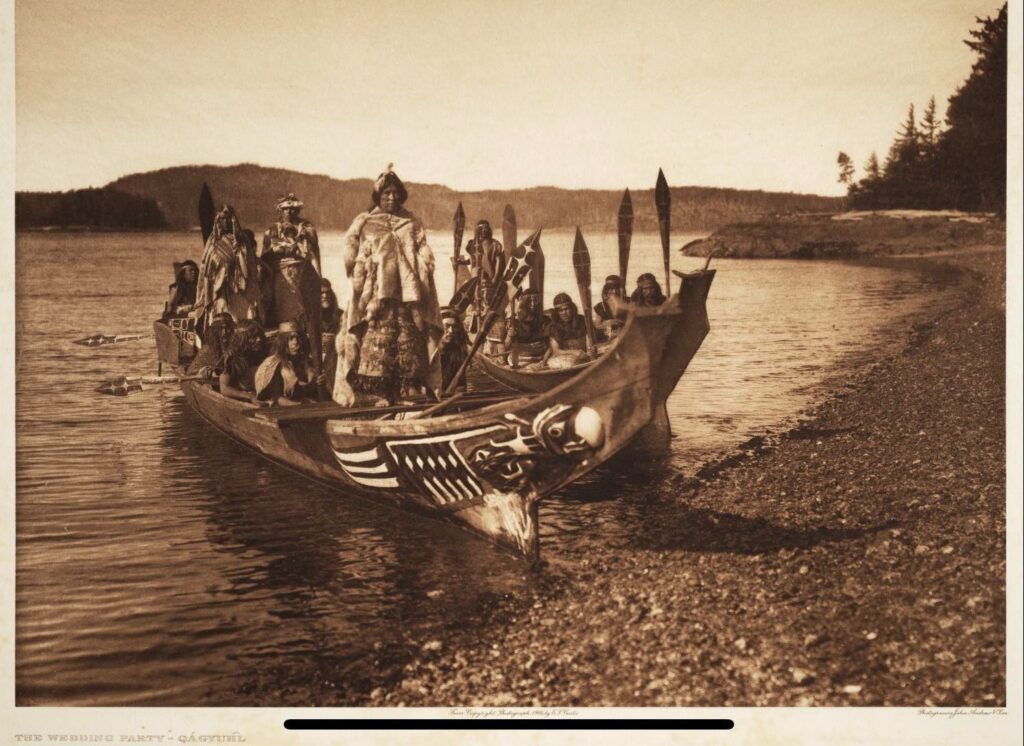
Leaving the main road, our gaze turned to the Dead Man’s Island, an absolute restricted area on the east side of the park, tightly locked with barbed wire and strictly off-limits to outsiders.
Why would a park filled with laughter have such a terrifying name? The answer lies in the distant 1700s.
According to ancient Indigenous records, this place was once a brutal battlefield in a fierce civil war between the Salish tribes of the coast. One tribe captured a large number of women and children from the other as hostages. In exchange for their vulnerable families, two hundred young warriors from the other side voluntarily laid down their weapons and walked naked onto this isolated island as hostages. However, what awaited these young bodies was not peaceful forgiveness, but a brutal and merciless massacre. The blood of the two hundred warriors completely stained the island’s soil, and it is said that the next day, strange red moss grew on the island. The Indigenous people, in their grief, placed the remains of the dead in specially made cedar wood boxes and hung them high on the branches of trees on the island, making this place both the most sacred and the most eerie tree burial site in Vancouver’s history.
Between 1888 and 1892, a deadly smallpox epidemic swept through the newly founded city of Vancouver. Due to the city’s medical collapse, the island of the dead, originally a cemetery, was urgently requisitioned and transformed into an isolated smallpox quarantine zone and “plague huts.” Countless desperate patients died tragically in the simple huts on this cold, desolate island. Their bodies were hastily buried by the living under layers of mud and weeds, turning the island into a massive, overlapping mass grave.
However, on this cursed land intertwined with blood and disease, in 1899, an armed standoff that shocked all of Canada broke out—known as the Battle of Dead Man’s Island.
In the spring of 1899, Theodore Ludgate, an ambitious American industrial magnate, did something that enraged the entire Vancouver elite. Through collusion with officials within the Ottawa federal government, he exploited a legal loophole and forcibly signed a 25-year lease agreement for Deadman’s Island for a paltry $500 per year. Ludgate vowed to cut down all the island’s century-old trees and build a massive steam-powered sawmill on the spot.
The news caused an uproar throughout the city. Especially the wealthy and powerful residents of the West End, Vancouver’s most prestigious neighborhood across the park at the time, could not tolerate their unparalleled views of the Pacific Ocean being completely destroyed by billowing black smoke and sawmill noise, nor could they bear the prospect of their luxury homes being halved in value. This was not merely a simple environmental dispute, but a life-or-death struggle for interests between foreign capitalists and local political elites.
At 6:30 a.m. on April 24, 1899, a thick fog blanketed the sea. Ludgate hired over 30 burly lumberjacks armed with axes and chainsaws, and they forcibly landed on the island, intending to seize the land and forcibly cut down trees. Before landing, Ludgate even arrogantly told the media, “If the Vancouver police dare to stop me, I will launch a city-wide protest tomorrow and force the mayor to resign!”
However, he underestimated the ruthless tactics of local politicians. As Ludgate and his workers swaggered into the dense forest, then-Vancouver Mayor James Garden, along with almost all of Vancouver’s heavily armed police, were already lying in wait in the shadows of the ancient trees.
As Ludgate arrogantly raised his axe and began chopping down the first redwood, Mayor James Garden emerged from the shadows.Under the cold gun barrels of the entire crowd, the mayor read out Vancouver’s first-ever Riot Act, ordering the entire police force to draw their weapons and arrest the arrogant industrial tycoon on the spot!
This legal and financial battle over the ownership of Dead Man’s Island dragged on in court for over a decade. Even more bizarrely, the police officers responsible for patrolling the forest on the island at night, who were stationed there year-round, frequently submitted unbelievable reports to the police department. They claimed that deep within the dense forest at night, they could hear the crisp cracking sounds of bones clashing and sharp screams like human skin being torn apart, as if warning any living person who dared to cut down trees there. The then-Vancouver Police Chief even had to jokingly approve a special order: officers patrolling Dead Man’s Island at night must carry high-intensity special torch.
Although Ludgate ultimately won the lawsuit in 1911 and forcibly cut down all the trees on the island, his company went bankrupt during the protracted litigation, and his massive sawmill ultimately vanished. This desolate island, cursed by blood and plague, remained closed and quiet until 1942, during World War II, when it was officially taken over by the Canadian Navy.
Chapter Two: The Mystery of the Disappearance of the Nine O’Clock Cannon
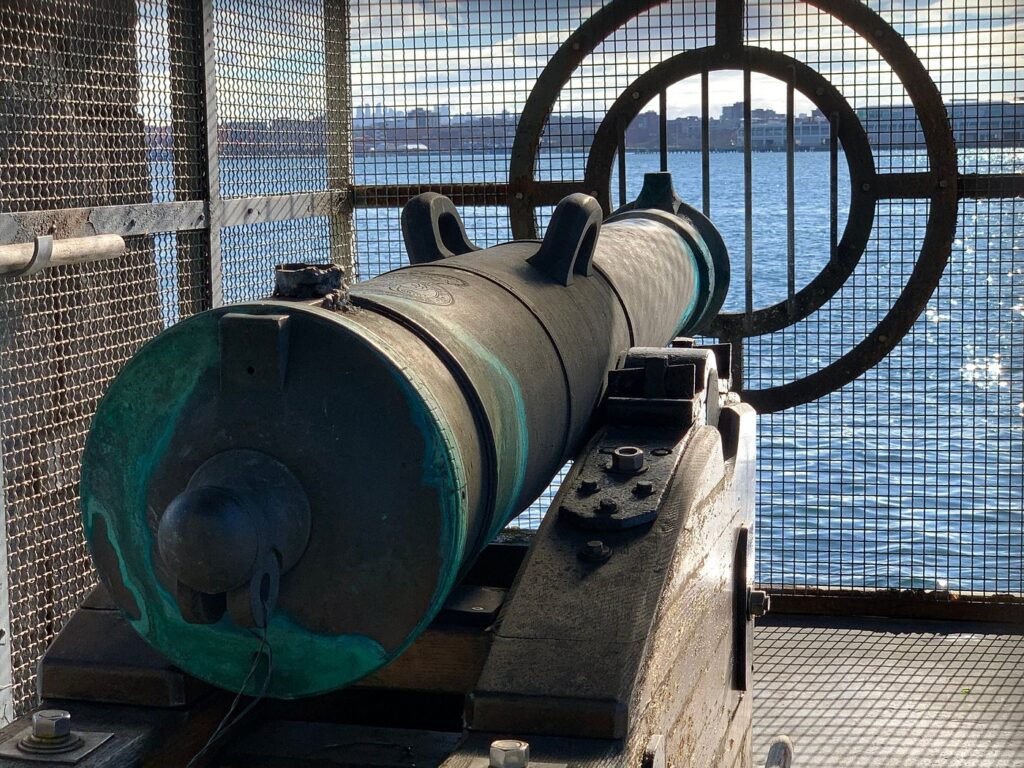
Walking north along the seawall path, at the Royal Presbyterian Point in the park, stands a 200-year-old cast iron cannon—the Nine O’Clock Cannon.
Since 1898, this ancient cannon, like the pulse of the city, fired precisely at nine o’clock every night, telling the time for fishermen at sea and citizens throughout the city. As accurate as a Swiss watch, it never made a mistake. Until one late night in February 1969.
That night, this iron cannon, weighing several tons and deeply embedded in solid rock, mysteriously disappeared without warning, even as the entire city was on high alert!
The next morning, when the workers arrived at the scene, they found only a bare base where the cannon had once stood. Vancouver was instantly plunged into shock and panic. Rumors spread like wildfire: some said aliens had taken it, others said it was retribution from ancient gods for plundering Indigenous lands. But the professionally forged evidence left at the scene quickly pointed to a group of highly intelligent “outlaws” in Vancouver—hardcore students from the University of British Columbia’s (UBC) Faculty of Engineering.
In Vancouver, this group of engineering students, known for their iconic red jackets and notorious for planning hardcore pranks that have made headlines worldwide, calls themselves UBC’s “Engineering Pranks.” They habitually commit their crimes in February, at the start of Engineering Week. In 1969, during Engineering Week, they targeted the Nine O’Clock Cannon.
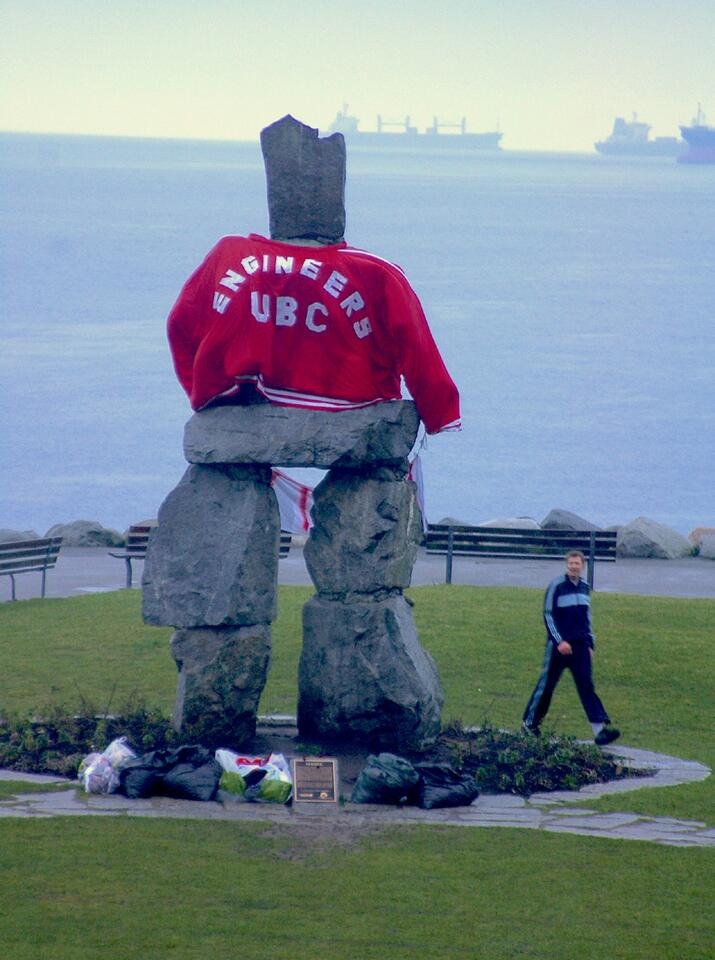
However, this historic “cannon hijacking” turned into a major farce on the night it was carried out.
These self-proclaimed engineering geniuses, due to errors in calculus and mechanics formulas, severely underestimated the cannon’s weight when calculating its volume. It wasn’t until they pried open the lock and stormed into the wooden shed, ready to move the cannon, that they were horrified to discover that this solid cast-iron behemoth weighed a staggering 1800 pounds, nearly a ton! That night, in the darkness, these highly intelligent students unleashed a torrent of profanities while furiously criticizing their classmates’ math final exam scores. Because the cannon was so heavy, they had to urgently call over twenty strong men waiting in the parking lot outside. Gritting their teeth and contorting their faces, they exerted every ounce of strength to lift the giant cannon onto a pickup truck using only manpower.
As dawn broke, newspapers throughout the city crackled to attention, and Vancouver police launched a citywide manhunt for the missing artifact. Meanwhile, this group of immature, red-jacketed students, exhausted and starving after a night of running around, brazenly drove their pickup truck, laden with a ton of stolen goods, into Vancouver’s most famous drive-in restaurant, White Spot. They casually munched on burgers outside, nonchalantly glancing at the Royal Cannon covered by a tarpaulin in the back of the truck—a truly comical scene.
Subsequently, the group of students secretly transported the cannon to the local area.Private residence of a professor in the Department of Civil Engineering at UBCThey forcibly shoved a one-ton cannon into the professor’s garage. They even arrogantly sent a ransom note to the Vancouver city government, made of newspaper clippings and collages, along with a photo of the cannon as a “hostage” taken in the garage, demanding that Mayor Tom Campbell immediately donate a $100 ransom to the children’s hospital.
Mayor Tom Campbell was hospitalized that day for surgery, and Deputy Mayor Hugh Bird was in charge of the city government. He dismissed the absurd request, but the people of Vancouver were completely won over by the students’ sense of humor. Suddenly, citizens and businesses spontaneously flocked to the mayor’s office, raising a staggering $400 CAD for the children’s hospital! This far exceeded the ransom demanded.
Privately, these “criminals” contacted the Vancouver police and arranged to return the cannon intact on Thursday noon. On the day the cannon was promised to be returned, Prospect Point in Stanley Park was packed with hundreds of onlookers and reporters with cameras set up to gather material. A deep red double-decker bus, carrying a large group of engineering students in red jackets, drove into the park with great fanfare.
Before everyone’s eyes, a group of students in red jackets were seen carrying a large, black cannon, and with a “plop,” they threw it into the sea! As the audience erupted in heartbroken screams for the destroyed artifact, the black thing miraculously floated to the surface of the calm water, eliciting laughter from the crowd. It turned out to be a replica wooden cannon, while the real royal cannon had been secretly handed over to the Vancouver Park Board at the agreed location at the same time.
So why did the city government, despite its strong rhetoric, ultimately not arrest a single student? A tacit secret still circulates in Vancouver: because among the top engineering students at UBC responsible for stealing the cannon…It is said that one of the leaders is the deputy mayor’s own son.The father is sternly reprimanding his son on TV, while the son is secretly laughing at the cannon in his dorm room. This is a classic case of “the flood washing away the Dragon King’s temple, family members turning against each other.” What can a father do when he sees his unruly child causing trouble?
Although it was a heartwarming charity prank, the Vancouver government was thoroughly terrified by the engineering students’ hands-on skills. After the cannon was returned to its original location, the city government worked through the night to weld the Nine O’Clock Cannon firmly to the rock foundation with steel bars. They also built a thick stone wall and iron cage around the cannon, preventing any future UBC students from attempting to “kidnap” it again. This ancient cannon, weathered by time, finally found its most peaceful respite in over a century within its iron cage.
And from then on, all was well? If you think that’s all there is to it, you’re sorely mistaken! Did you think these UBC engineering students would stop after stealing the Nine O’Clock cannon and messing with the city government? Wrong. In their view, their overflowing intelligence and hardcore physics knowledge needed a bigger stage to shine. So, the Ladner Clock Tower, several tens of meters high on the UBC campus, became their next “victim.”
One day in 1980, overnight, a bright red, old-model Volkswagen Beetle appeared out of thin air at the very top of the tower! When the entire school looked up in the morning, their eyes nearly popped out of their sockets: without a crane, how the hell did these people manage to put a car up there?!
For these “highly intelligent lunatics,” parking the car on the clock tower was nothing more than a “newbie village” task.
Late at night in 1988They decided to pull off something big. This group of engineering students, dressed in their signature red jackets, bypassed all security and patrols and quietly infiltrated Vancouver’s vital transportation artery—the Lions Gate Bridge!
As the first light of dawn illuminated Vancouver the following morning, rush-hour drivers were shocked to discover a red car suspended in mid-air above the bridge! Huge white letters were sprayed on either side.“E”— Represents Engineers.
Traffic police, bridge experts, and even special police all rushed to the scene, scratching their heads in frustration.
Do you think this is the peak? No, their ambitions have long since spread beyond Canada!
In 2001, this prank team secretly infiltrated San Francisco, USA. On a foggy night, they hung identical red Volkswagen Beetles directly on a world-famous landmark—Golden Gate BridgeBelow the steel frame!
Traffic in San Francisco came to an instant standstill, alarming the US police and the national media.
But after experts from across the United States rushed to the scene and cautiously disassembled the car body for inspection, the chief engineer of the Golden Gate Bridge couldn’t help but publicly praise it:“Although they broke the law, it must be admitted that the mechanical design of this pulley suspension system is extremely perfect! It did not cause any structural damage to the bridge at all.”
Even more outrageous is that this kind of “hardcore prank” has actually become a century-old tradition of UBC.
February 2008Exactly 20 years later, a new generation of students, in order to “pay tribute to the legend,” braved strong winds and heavy rain to recreate this famous scene on the Lions Gate Bridge.It was perfectly replicated once again.!
Facing the media’s cameras, the group of young people in red jackets swaggered out and issued a statement:
“Don’t be nervous, we’re not trying to cause damage. We just want to show all of humanity the limits and wonder of modern engineering in the most hardcore way!”
Don’t get too excited. A bill for the car dismantling was slammed onto the table of these thugs. “What goes around comes around.”
This prank tradition has even continued to this day. Not long ago…End of March 2026A red Volkswagen Beetle with a huge “E” logo has appeared out of nowhere on the cliffs of Squamish, a rock climbing mecca near Vancouver, British Columbia! This has once again caused a huge sensation among the local climbing community, Indigenous people, and the police.
Who knows what kind of trouble these young men in red jackets will cause next?
Chapter Three: The Hollow Tree and the Red-Clad Ghost in the Forest
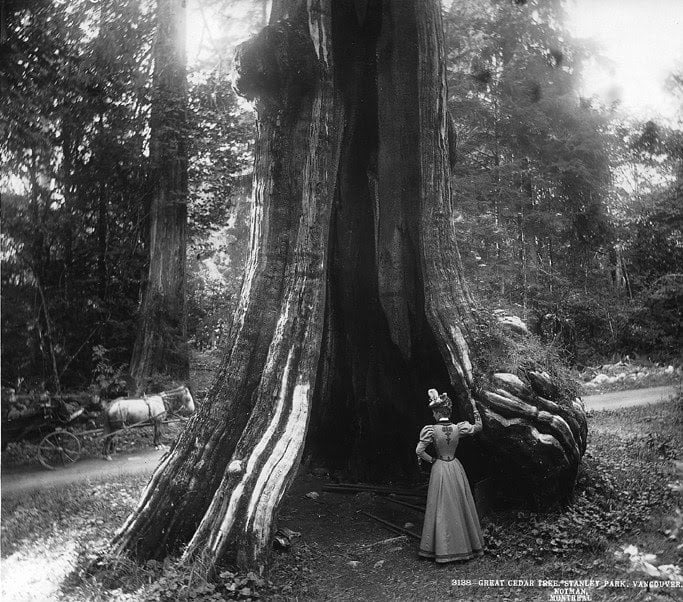
When it comes to Stanley Park’s most famous natural landmark, it has to be the “hollow tree” that is nearly a thousand years old.
In the early 1900s, with the opening of the Ring Road, the archives of the local media outlet 604 Now contained countless photos that became the first “Instagrammable” photos, sweeping across North America. Gentlemen and ladies of that time, dressed in gorgeous Edwardian gowns, rented luxurious carriages for sightseeing, and even drove the city’s earliest Ford Model T cars directly into this huge, completely hollow redwood hollow to take photos.
In those days, being able to drive into the tree hollow was a symbol of status and wealth. But older generations of Vancouverites all knew a closely guarded secret: never be alone, especially at dusk or late at night, and gaze at the dark tree hollow for too long.
It was a cold, gloomy evening in 1947. A young couple was taking a walk past a hollow tree. As it was getting dark, the girl jokingly went into the hollow tree alone, wanting to experience the feeling of a thousand years of emptiness. However, just seconds after she entered, an extremely shrill and chilling scream suddenly came from inside the hollow tree.
Her boyfriend rushed into the tree hollow like a madman, only to find the girl slumped on the damp, muddy ground, her eyes wide with terror, trembling all over, her finger pointing desperately at the top of the tree trunk, into the pitch-black depths where the sunlight couldn’t reach. In a trembling voice, the girl said that just moments before, when she looked up, she saw a “red-clad man” dressed in old-fashioned 19th-century road worker’s clothes, hanging upside down at the very top of the tree hollow, his feet dangling in the air. The man’s face was deathly pale, and his lifeless eyes were fixed on her at the bottom of the hollow.
This horrific experience caused the girl to suffer a mental breakdown. Even more intriguing, and chillingly, is a detail clearly recorded in the Vancouver City Archives’ road construction history: in the 1880s, during the construction of the Stanley Park loop road and seawall walkway at dawn and dusk, a Chinese laborer wearing a red shirt mysteriously disappeared while clearing dense woods near hollow trees. His coworkers dug deep, but found nothing; he was neither alive nor dead.
Could it be that during that era of bloodshed and tears in the construction of the highway, this missing Chinese laborer encountered some unknown accident? And his soul, for the past hundred years, has been imprisoned in this thousand-year-old hollow tree, watching over every living person who ventures into this forest?
Chapter Four: The Ancient Totem Pole at Brockton Point
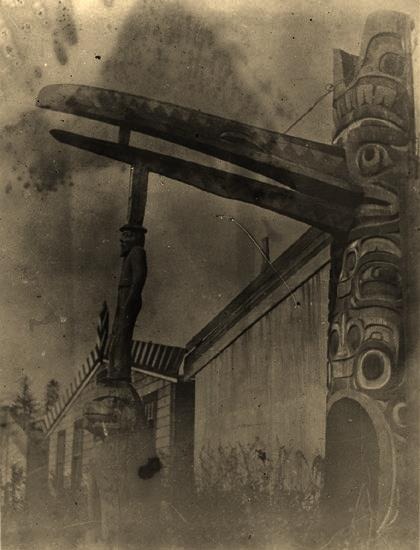
Leaving the hollow tree, which is steeped in urban ghost stories, we followed the coast to Brockton Point by the sea.
On a flat, green lawn, several tall, brightly colored Indigenous totem poles stand quietly, welcoming the Pacific breeze. This is the most visited tourist attraction in all of British Columbia, but few visitors truly understand the meaning behind these wooden carvings.
In the beliefs of the indigenous people, these totem poles are definitely not idols for worship, but rather “history textbooks” and “family laws” carved from wood and passed down through generations.
Each animal image on a totem pole is a tangible embodiment of an ancient tribal history. The enormous thunderbird at the top, with its outstretched wings, symbolizes supernatural dominance and supreme majesty; the black bear below, with its mouth wide open, represents boundless power and the protective love of a mother; while the killer whale swims at the base of the pole, guarding the secrets of the ocean and the tribe’s territory. Every exaggerated, even somewhat ferocious-looking, facial expression at dusk, proclaims to the world the glory and betrayal this tribe has experienced.
However, these exquisite works of art have also been victims of political and commercial interests in the past. In the 1920s, in an effort to transform the newly founded Vancouver into an international tourist city, the Vancouver Park Board made a highly controversial decision. Instead of inviting local tribes to create their own totem poles, they sent officials with large sums of cash to northern Vancouver Island and even the remote Haida Gwaii Peninsula to “acquire” ancient totem poles from various tribes there, and then forcibly placed them in Stanley Park.
For indigenous peoples, totem poles are alive; they carry the resentment of the tribe and the glory of their ancestors. According to ancient tradition, a totem pole, from the day it is erected, should be allowed to decay and crack naturally in the wind and rain, “dust to dust, ashes to ashes.” Any forced movement or repair is considered disrespectful to the ancestral gods.
To quell the controversy and protect the artifacts, the original batch of old totem poles, bearing the marks of colonial acquisition, have long since been moved to various museums and properly preserved. What we see at Cape Brockton today are mostly replicas, sculpted on the original site by master sculptors who are descendants of the Indigenous people.
Yet, in the still of the night, when the sea breeze sweeps across Brockton Point, these towering wooden sculptures emit a low, grinding sound. In the deep forest at night, are they truly just still pieces of wood? Or are they, with their sculpted eyes, coldly scrutinizing this modern civilization that has intruded upon their home, carrying an ancient melancholy?
Chapter 5: The Money Struggle and Miraculous Reversal Behind the Lions Gate Bridge

As we emerge from the ancient totem poles, we are greeted by the ultimate legend of the modern industrial and capitalist world—the Lions Gate Bridge.
This magnificent suspension bridge, spanning the First Strait, is hailed as a miracle of human engineering in countless travel brochures. However, a closer look at its history reveals that the bridge’s creation was not a government-led infrastructure project for the benefit of the people, but rather a ruthless and textbook example of capitalist exploitation.
The story takes place in the 1930s, during the Great Depression, one of the darkest periods in North American history. In 1931, West Vancouver was on the verge of bankruptcy. At that time, the Guinness family, a top beer tycoon based in Ireland, astutely set their sights on the vast, undeveloped land on Vancouver’s North Shore.
Taking advantage of the city’s economic collapse, widespread bankruptcy, and displacement, the Guinness family, with astonishing transnational capital, aggressively bought up 4,000 acres of land in West and North Vancouver at a bargain price of only $18.75 per acre. Although they acquired the land, this wasteland was separated from the city center by a strait. To maximize the land’s value, the Guinness family invested $6 million to build the bridge connecting the city center to the North Shore. During construction, they brutally cut through Stanley Park’s old-growth forest, forcibly leveling 10 acres to build the Causeway. This sparked a massive wave of angry protests from Vancouver residents. Citizens took to the streets, condemning the transnational capital’s plunder of public natural resources.
However, the protests were ruthlessly crushed by the power of capital. When it opened in 1938, it was a completely privately owned toll bridge. The toll was a whopping 25 cents, equivalent to $5 today! Such a high barrier had only one purpose: to exclude the poor and maintain the extremely high-end, affluent communities they were developing – “British real estate”.
This monopolistic profiteering over the city’s transportation lifeline continued until 1955. The provincial government could no longer tolerate the capitalists’ exploitation of the city’s transportation system and eventually intervened, forcibly acquiring ownership of the bridge at the original construction cost. The tollbooth was not finally demolished until 1963.
In 1986, during the Vancouver World Expo, the Guinness family, seeking to revamp their brand image, proposed funding the installation of iconic nighttime lighting on the bridge. This led to the iconic “pearls of light” that illuminate the Vancouver night sky today. At the bridge entrance, the two majestic stone lion statues, created by sculptor Marega, seem to still sit in the darkness, faithfully guarding the vast wealth empire of the Guinness family, now living in seclusion across the ocean.
However, there’s a little-known secret hidden about this incredibly wealthy Guinness family. Does the name “Guinness” sound familiar? That’s right, it’s the inventor of the renowned “Guinness World Records.”
In 1951, back when the Guinness family was still rife with tolls collected across the Lions Gate Bridge in Vancouver, Sir Hugh Beaver, the managing director of the brewery, was attending a hunting party in a forest in Ireland. At the moment of firing, due to his slow reaction, he missed a golden plover in flight.
At the dinner that followed, Sir Hugh Beaver, feeling embarrassed, started a heated debate with his friends at the table to cover up his awkwardness: Is the fastest game bird in Europe the golden plover or the red grouse?
They searched through all the reference books and encyclopedias in the castle, but found no definitive answer. At that moment, a brilliant idea flashed into the shrewd businessman’s mind: every day, in thousands of bars across the world, how many drunkards argue heatedly, even to the point of physical fights, over such trivial matters? If there were a book that could provide the ultimate, definitive answer to all these absurd arguments, it would undoubtedly become the most essential resource in those bars!
He acted immediately. So, he hired two fact-checking experts who specialized in collecting bizarre data to compile a book that gathered all sorts of world records. To prevent drunks from tearing the book apart in bars, the earliest version even had a special waterproof and oil-proof coating, and was given away as a free marketing gift with the purchase of Guinness stout to various bars.
Unsurprisingly, this handbook, intended for calming bar fights, became an instant hit and unexpectedly became one of the best-selling copyrighted books in publishing history—the famous Guinness World Record. For this, Sir Hugh Beaver was awarded the Order of the British Empire (KBE) in 1960. He proved with a single “missed target” mistake that success cannot be planned; anything is possible as long as you have curiosity.
The Guinness family dominated pubs with beer, bought up Vancouver with a bridge, and monopolized humanity’s curiosity with world records. But the most ironic twist of history has occurred: after half a century of complex global business changes and capital restructuring, the actual asset copyright of this globally popular “Guinness World Records” brand, founded by the Irish beer giant, has long been sold to the Jim Pattison Group.
The owner of this group, Jim Pattison, is none other than a top business tycoon with a net worth of over 10 billion dollars, ranking first in Vancouver.
The symbols of an empire built by multinational capital through bargain hunting in Vancouver have, after more than half a century of twists and turns, ultimately returned to the hands of Vancouver’s native owners in a highly dramatic manner.
Ending: The Silence of the Forest
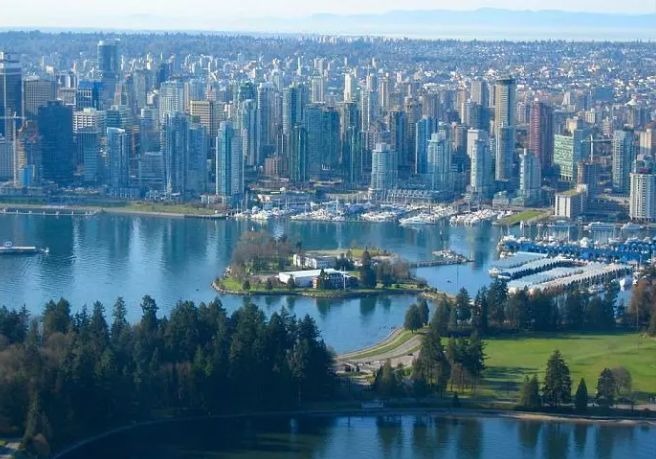
Stanley Park’s beauty lies in the fact that it is half paradise-like natural scenery and half profound and unfathomable historical mystery.
From the nameless skeletons beneath the Wailing Wall on Dead Man’s Island to the harrowing riot and arrests of 1899; from the supernatural mystery of the Nine O’Clock Cannon’s disappearance to the red-clad ghost hanging upside down in a hollow tree for a hundred years; to the ancient totem poles sleeping at Brockton Point, and the Lions Gate Bridge, which was bought up by transnational giants and eventually returned to its homeland, along with its “world record”.
This fully demonstrates that on this land of 400 hectares of primeval forest, more than a hundred years of silence have concealed too much unknown bloodshed, the pursuit of capital, and mysterious unsolved cases.
Next time you walk beside the beautiful Lions Gate Bridge, or stroll along the deserted seawall promenade, take a moment to pause and pay attention to the dense forests rustling in the sea breeze.
Because, perhaps in the very instant you turn your head, a chilling shadow from the depths of history is quietly watching you.